



curl -LsSf https://langch.in/dcode | bash# With model provider extras
# OpenAI, Anthropic, and Gemini are included by default
DEEPAGENTS_CODE_EXTRAS="nvidia,ollama" curl -LsSf https://langch.in/dcode | bashRun:
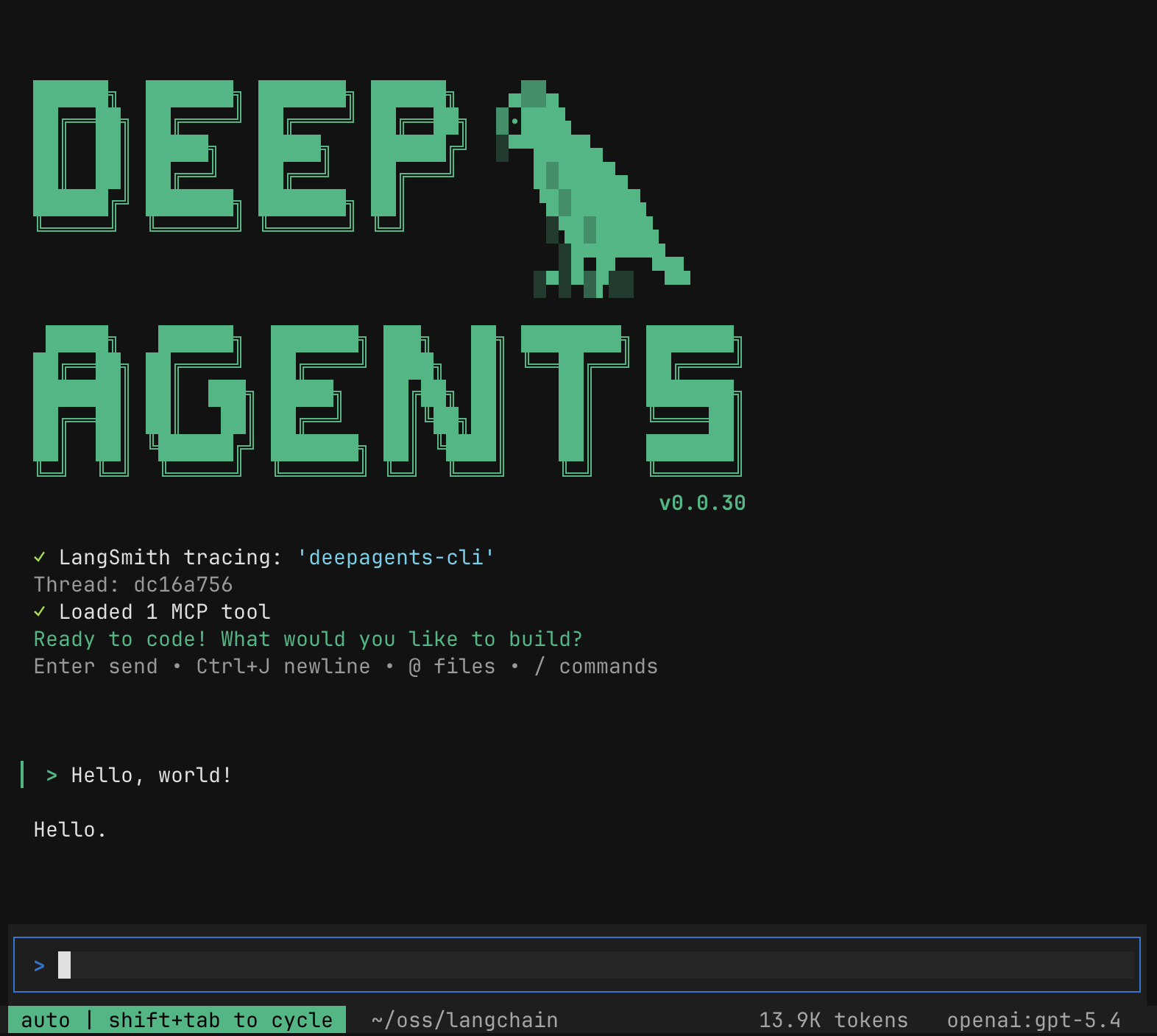
dcodeThe fastest way to start using Deep Agents. deepagents-code is a pre-built coding agent in your terminal — similar to Claude Code or Cursor — powered by any LLM that supports tool calling. One install command and you're up and running, no code required.
What deepagents-code adds on top of the SDK:
- Interactive TUI — rich terminal interface with streaming responses
- Conversation resume — pick up where you left off across sessions
- Web search — ground responses in live information
- Remote sandboxes — run code in isolated environments (LangSmith, AgentCore, Daytona, Modal, Runloop, & more)
- Persistent memory — agent remembers context across conversations
- Custom skills — extend the agent with your own slash commands
- Headless mode — run non-interactively for scripting and CI
- Human-in-the-loop — approve or reject tool calls before execution
By default, dcode trusts the directory you run it in. Human-in-the-loop approval gates model-requested tool calls, but project artifacts are read before any approval prompt.
Do not run dcode in a directory you do not trust without a sandbox backend. For untrusted repositories, use a remote sandbox so execution is isolated from your machine. Running dcode in a directory lets that directory's files shape execution. See THREAT_MODEL.md for details.
- Documentation
- Changelog
- Source code
- Deep Agents SDK — underlying agent harness
- LangChain Academy — Comprehensive, free courses on LangChain libraries and products, made by the LangChain team.
- Code of Conduct — community guidelines and standards
See our Releases and Versioning policies.
As an open-source project in a rapidly developing field, we are extremely open to contributions, whether it be in the form of a new feature, improved infrastructure, or better documentation.
For detailed information on how to contribute, see the Contributing Guide.
This project was primarily inspired by Claude Code, and initially was largely an attempt to see what made Claude Code general purpose, and make it even more so.