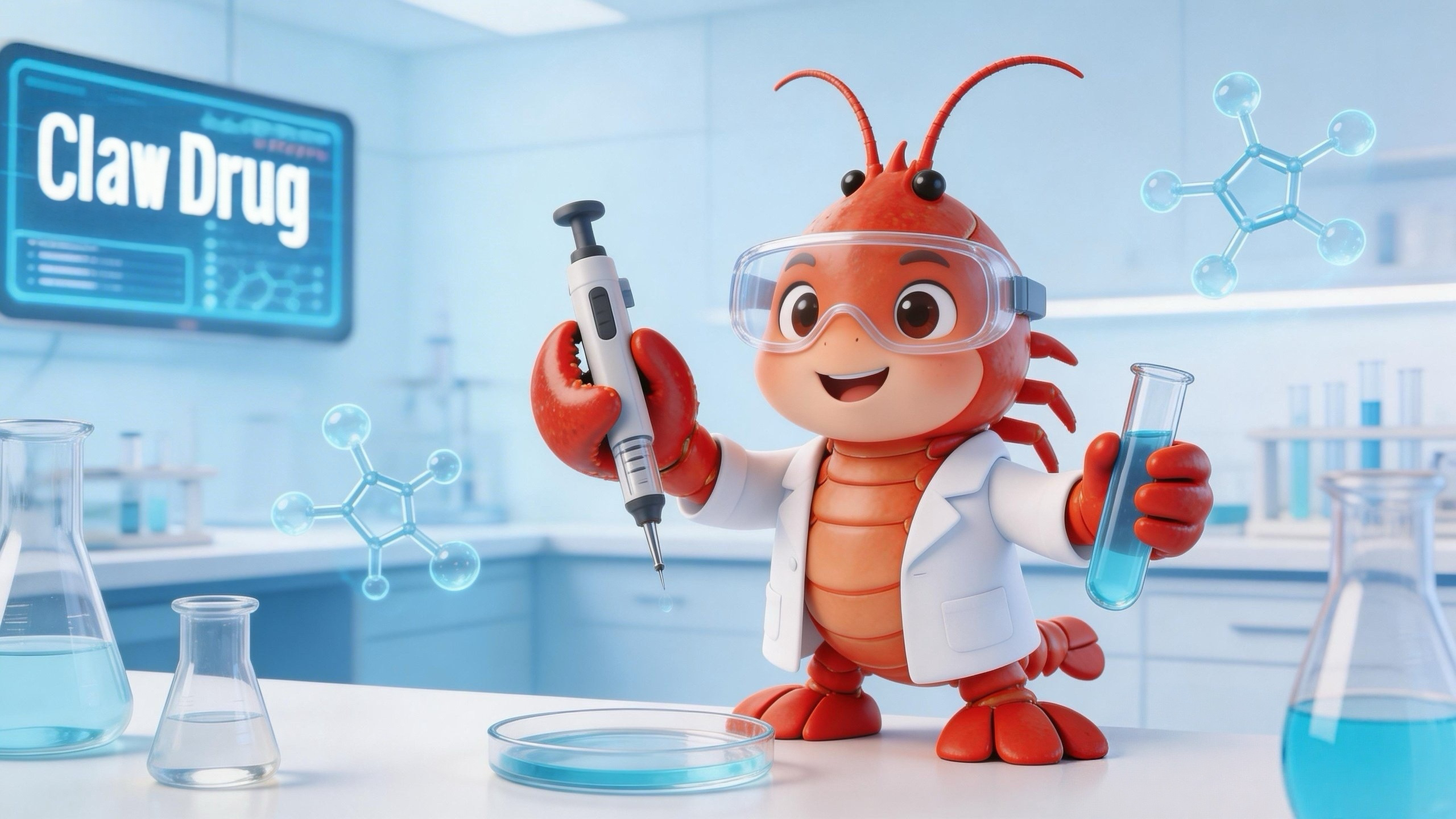
AI-powered full-stack drug discovery assistant based on OpenClaw
Accelerate your drug discovery workflow from literature analysis to experimental design




DrugClaw is an OpenClaw-native full-stack drug discovery assistant. Just talk to it like you talk to me - it does the work for you.
✅ Completely conversational - No scripting, no command-line fighting, just tell it what target you're interested in, it plans and executes step-by-step
✅ Full pipeline from literature to candidate molecules - From literature review to virtual screening, you get a ranked list of candidate molecules ready for experimental validation
✅ 15-category skill tree - Covers drug-target interactions, adverse reactions, drug-drug interactions, pharmacogenomics, drug repurposing, and more
✅ Agentic "vibe coding" - Each data source has a SKILL.md + example.py, the CodeAgent writes the query code for you, no need to pre-write everything
✅ Three-level fallback - Pre-written scripts → LLM code generation → skill module, always gracefully degraded
Give it a target protein that you think is associated with a disease, it will help you find candidate small molecule binders. That's it.
DrugClaw covers the full drug discovery pipeline with an agentic workflow:
- Literature Analysis - Automatic PubMed search, key information extraction, trend analysis
- Target Intelligence - Build target dossiers from UniProt, OpenTargets, Reactome, STRING, ClinVar
- Evidence Synthesis - Aggregate evidence from multiple databases for reasoned conclusions
- Virtual Screening - Automated molecular docking with AutoDock Vina, post-processing and ranking
- ADMET Prediction - Heuristic ADMET property prediction using ChemBERTa
- Drug-Target Interaction (DTI) - Query ChEMBL, BindingDB, DGIdb, TTD for known interactions
- Molecule Generation - Generate novel molecules based on scaffold constraints
- Experimental Protocol Design - Automatic cell/animal experiment protocol generation
- Statistical Analysis - Automated data processing, visualization and statistical testing
- Clinical Trial Design - Protocol design assistance, eligibility criteria selection
| Category | Description |
|---|---|
| Adverse Drug Reactions (ADR) | Query FAERS, SIDER, nSIDES for adverse drug reactions |
| Drug-Drug Interactions (DDI) | Check interaction data from multiple sources |
| Pharmacogenomics (PGx) | Query PharmGKB for genotype-guided dosing |
| Drug Repurposing | Identify repurposing opportunities from RepoDB, DRKG |
| And more... | See full skill tree below |
| Category | Description | Data Sources |
|---|---|---|
| dti | Drug-Target Interactions | ChEMBL, BindingDB, DGIdb, Open Targets, TTD, STITCH |
| adr | Adverse Drug Reactions | FAERS, SIDER, nSIDES, ADReCS |
| ddi | Drug-Drug Interactions | MecDDI, DDInter, KEGG Drug |
| pgx | Pharmacogenomics | PharmGKB, CPIC |
| repurposing | Drug Repurposing | RepoDB, DRKG, OREGANO, Drug Repurposing Hub |
| knowledgebase | Drug Knowledgebases | DrugBank, UniD3, IUPHAR/BPS, DrugCentral, WHO Essential Medicines |
| mechanism | Mechanisms of Action | DRUGMECHDB |
| labeling | Drug Labeling | DailyMed, openFDA, MedlinePlus |
| toxicity | Drug Toxicity | UniTox, LiverTox, DILIrank |
| ontology | Ontology & Normalization | RxNorm, ChEBI, ATC/DDD |
| combination | Drug Combinations | DrugCombDB, DrugComb |
| properties | Molecular Properties | GDSC, ChemBERTa |
| disease | Drug-Disease Associations | SemaTyP |
| reviews | Patient Reviews | WebMD, Drugs.com |
| nlp | NLP Datasets | DDI Corpus, DrugProt, ADE Corpus, CADEC |
- OpenClaw - Agent framework, skill system, memory, multi-channel support
- RDKit - Cheminformatics
- ChemBERTa-2 - Molecular property prediction
- ESMFold - Protein structure prediction
- DiffDock - Molecular docking
- AutoDock Vina - Virtual screening
- LangChain - RAG and agent orchestration
- OpenAI API - LLM for code generation and reasoning
# Clone the repository
git clone https://github.com/caroline-li-bot/DrugClaw.git
cd DrugClaw

# Create virtual environment
python3 -m venv .venv
source .venv/bin/activate

# Install dependencies
pip install -r requirements.txt

# Install the package
pip install -e .

# Install as OpenClaw skill
openclaw skill install .
See DEPLOYMENT.md for more deployment options.
If you have a protein target that you want to discover new binders:
# 1. Install system dependencies (AutoDock Vina, OpenBabel, MGLTools)
sudo ./scripts/install_system_deps.sh

# 2. Literature review - understand your target
drugclaw run --query "Summarize recent research on TREM2 role in Alzheimer's disease"

# 3. Get target information from public databases
drugclaw run --query "Get target information for TREM2 including function and disease association"

# 4. Download sample compound library
python scripts/download_public_datasets.py --dataset zinc_15_sample --output-dir ./data

# 5. ADMET pre-filtering (filter out bad compounds)
drugclaw run --query "Predict ADMET for all compounds in data/zinc_15_sample/2k-compound-sample.csv --output admet_filtered.csv"

# 6. Parallel virtual screening (uses all CPU cores by default)
drugclaw virtual-screening \
  --receptor ./trem2.pdb \
  --center-x 10.0 --center-y 20.0 --center-z 30.0 \
  --size-x 20 --size-y 20 --size-z 20 \
  --input ./admet_filtered.csv \
  --output ./trem2_screening_results.csv
That's it! You'll get a CSV ranked by binding affinity, top candidates are ready for experimental validation.
cp navigator_api_keys.example.json navigator_api_keys.json
# Edit navigator_api_keys.json and add your OpenAI API keydrugclaw doctor
drugclaw listdrugclaw demo# Simple query
drugclaw run --query "What are the known drug targets of imatinib?"
# Complex query with graph reasoning
drugclaw run --query "What are the adverse drug reactions and interaction risks of combining warfarin with NSAIDs?" --thinking-mode graph
# Save as Markdown report
drugclaw run --query "Which approved drugs can be repurposed for triple-negative breast cancer?" --save-md-reportThe best experience - just install and chat!
In OpenClaw chat, just ask naturally:
Find all known targets of imatinib and summarize potential adverse interactions
DrugClaw/
├── drugclaw/                    # Main Python package
│   ├── __init__.py
│   ├── agent/                   # Agent architecture
│   │   ├── planner.py           # Query planning agent
│   │   ├── code_agent.py        # Code generation agent
│   │   └── responder.py         # Final answer synthesizer
│   ├── cli.py                   # Command-line interface
│   ├── config.py                # Configuration handling
│   ├── kg/                      # Knowledge graph builder and reasoner
│   ├── rag/                     # Literature RAG system
│   ├── virtual_screening/       # Parallel virtual screening with AutoDock Vina
│   └── main_system.py           # Main system entrypoint
├── skills/                      # 15-category skill tree
│   ├── dti/                     # Drug-Target Interactions
│   │   └── chembl/              # Per-source skill: SKILL.md, example.py, retrieve.py
│   ├── adr/                     # Adverse Drug Reactions
│   ├── ddi/                     # Drug-Drug Interactions
│   ├── pgx/                     # Pharmacogenomics
│   ├── repurposing/             # Drug Repurposing
│   ├── knowledgebase/           # Drug Knowledgebases
│   ├── mechanism/               # Mechanisms of Action
│   ├── labeling/                # Drug Labeling
│   ├── toxicity/                # Drug Toxicity
│   ├── ontology/                # Ontology & Normalization
│   ├── combination/             # Drug Combinations
│   ├── properties/              # Molecular Properties
│   ├── disease/                 # Drug-Disease Associations
│   ├── reviews/                 # Patient Reviews
│   └── nlp/                     # NLP Datasets
├── utils/                       # Utilities
│   ├── chem_utils.py            # Cheminformatics tools
│   ├── db_utils.py              # Database utilities
│   ├── ml_utils.py              # ML models
│   └── sota_models.py           # SOTA models (ChemBERTa, ESMFold, DiffDock)
├── examples/                    # Example usage scripts
├── docs/                        # Documentation
├── support/                     # Project assets (logo, images)
├── scripts/                     # Installation and data download scripts
├── requirements.txt             # Python dependencies
├── pyproject.toml               # Package configuration
├── skill.yaml                   # OpenClaw skill manifest
└── README.md                    # This file
| Aspect | DrugClaw/DrugClaw | QSong-github/DrugClaw | caroline-li-bot/DrugClaw |
|---|---|---|---|
| Base | Rust agent runtime | LangGraph Agentic RAG | OpenClaw-native skill |
| Scope | Full research workflow automation | Drug knowledge QA | Full-stack drug discovery - from literature to candidate molecules |
| User Experience | Standalone service | CLI / API | Completely conversational - you talk, it does the work |
| Philosophy | Generic agent with drug skills | Structured skill tree, vibe coding retrieval | OpenClaw agent + 15-category skill tree + vibe coding + full pipeline to virtual screening |
- "What are the known targets, adverse effects, and interaction risks of imatinib?"
- "Which approved drugs may be repurposed for triple-negative breast cancer?"
- "What pharmacogenomic guidance exists for clopidogrel and CYP2C19?"
- "Are there clinically meaningful interactions between warfarin and NSAIDs?"
- "Predict ADMET properties for this SMILES:
CC1=CC=C(C=C1)NC(=O)C2=CC=C(O)C=C2"
MIT License - see LICENSE for details.
- Inspired by DrugClaw/DrugClaw and QSong-github/DrugClaw
- Built on top of the OpenClaw agent framework
- Uses publicly available biomedical databases and open-source tools
DrugClaw is for research purposes only. It does not provide medical advice. All predictions should be experimentally validated.