
A formal language and engine for constructing belief structures from evidence streams.
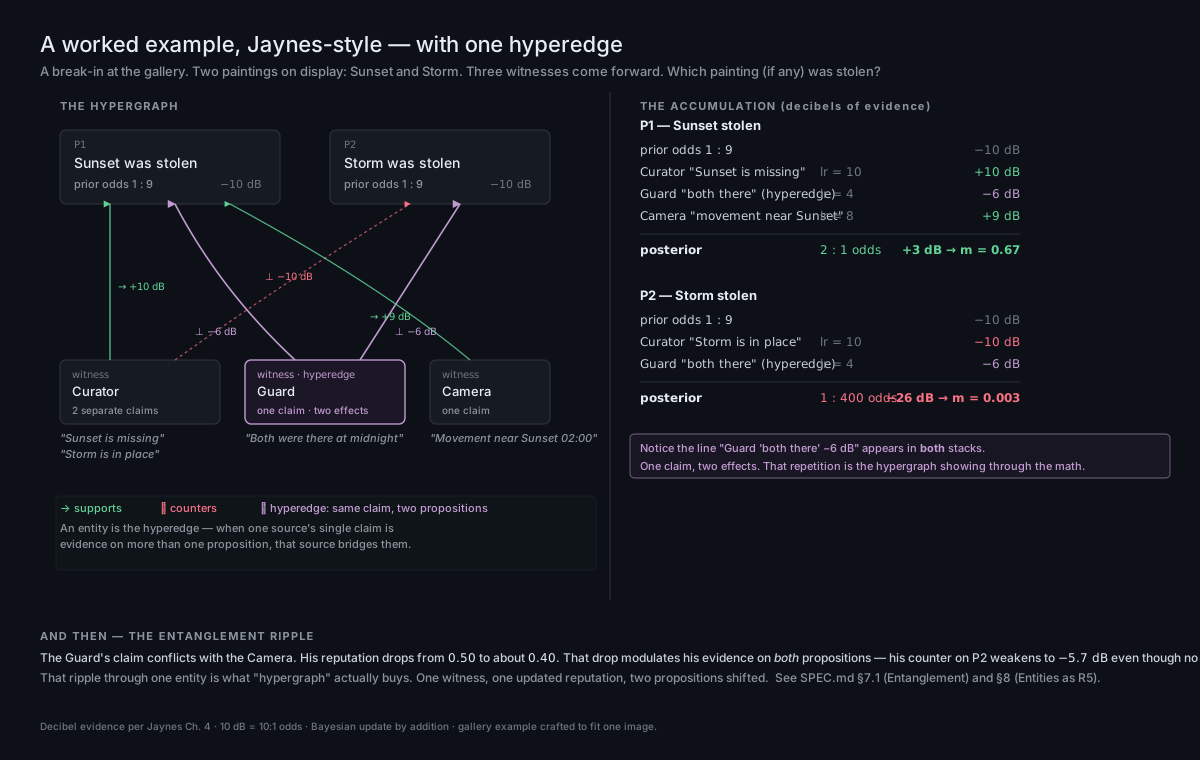
BELLA takes a stream of claims from diverse sources and progressively builds an epistemic belief tree — a structured representation of what is known, disputed, and uncertain about a topic.
claim₁ → BELLA → P1: "building collapsed" (m=0.72, 3v)
claim₂ →              P2: "survivors rescued" →P1 (m=0.54, 1v)
claim₃ →              P3: "structural violations" →P1 (m=0.47, 0v)
claim₄ →                ⊥ P4: "owner denies violations" (m=0.53, 1v)
Each node is a proposition — not a claim, but an abstract belief. Claims accumulate as evidence, updating Bayesian mass. Disputes are structural: a counter (⊥) child explicitly contradicts its parent.
Propositions are abstract beliefs, not raw claims. Multiple claims can confirm the same proposition.
Relations are typed:
→supports/implies (child is evidence for parent)⊥counters/denies (child explicitly disputes parent)
Mass is Bayesian (Jaynes): m = σ(Σ log lr) where lr is the likelihood ratio of each piece of evidence.
Voice count captures source independence — how many independent sources confirm.
Assessment is the pair (m, |V|) — no arbitrary categorical labels.
The Gene is a compact representation of the belief tree that grows with each claim, providing context for routing the next one.
BELLA separates three things:
- The kernel — six fixed rules (R1–R6) that read evidence and build structure. Small, stable, never changes.
- The gene — a compact text representation of everything the system knows. Grows with each claim. Transmissible.
- The belief tree (KB) — the expressed structure: propositions with mass, edges with relations, disputes made visible.
The kernel reads the gene to produce the KB. Any instance of BELLA with the same kernel can read a gene and reconstitute a functionally equivalent KB — not bit-identical, but able to answer the same queries with the same confidence.
This is the same three-tier pattern biology uses for heredity (DNA / ribosome / protein). BELLA was not designed to imitate it; the architecture was forced by the problem of accumulating belief across streaming evidence. See SPEC.md — Foundation section — for the full account.
-- Propositions
P<n>: "3-8 word description" (m, |V|v)

-- Relations
→  supports/implies
⊥  counters/denies

-- Actions (one per claim)
⊨ P<n>                     -- confirm existing proposition
⊨ P<n> ∧ δ"detail"          -- confirm + amend with nuance
⊢ P<new> → P<n> "desc"      -- new proposition supporting P<n>
⊢ P<new> ⊥ P<n> "desc"      -- new proposition countering P<n>
⊢ P<new> "desc"              -- new unrelated root
Pass 1 (Structure): Claims stream in one at a time. Each claim is evaluated against the current gene (compact belief tree). One LLM call per claim produces one action. The gene grows progressively.
Pass 2 (Evidence): Claims are assigned to propositions with Bayesian likelihood ratios. Mass accumulates. The pair (m, |V|) captures both evidence quality and source independence.
| Dataset | Claims | Propositions | Roots | Cost |
|---|---|---|---|---|
| Iran-US F-35 fighter jet incident (93 claims) | 93 | 44 | 3 | $0.29 |
| Jeffrey Epstein death investigation (75 claims) | 75 | 47 | 2 | $0.22 |
Both produce correct epistemic structure: disputes identified, voices accumulated, Bayesian mass computed.
SPEC.md       Formal specification (six rules, gene, invariants)
VISION.md     Theoretical grounding — Jaynes, Gödel, consciousness
JAYNES.md     What BELLA inherits from / extends / specializes in Jaynes
WHY.md        The epistemic crisis BELLA addresses
MEMORY.md     BELLA applied to LLM agent memory
EXAMPLES.md   Domain-agnostic case studies
TEASER.md     Short pitch
CHANGELOG.md  Version history

kernel.py     The kernel implementation
grow.py       Belief-tree growth engine
cli.py        Command-line interface
*.html        Visual diagrams and prototypes

replay/       Historical-event validation harness
              (Wirecard, Theranos, Wakefield, Hydroxychloroquine)
See SPEC.md for the full formal specification.
v0.1 — Language defined, validated on two domains. Engine is experimental.
The empirical tool bellamem
applies this calculus as persistent memory for LLM coding agents.
MIT
If you use BELLA in research, please cite:
BELLA: Bayesian Epistemic Logical Lattice for Accumulation
Recursive Emergence / HereNews Project, 2026
https://github.com/Recursive-Emergence/bella