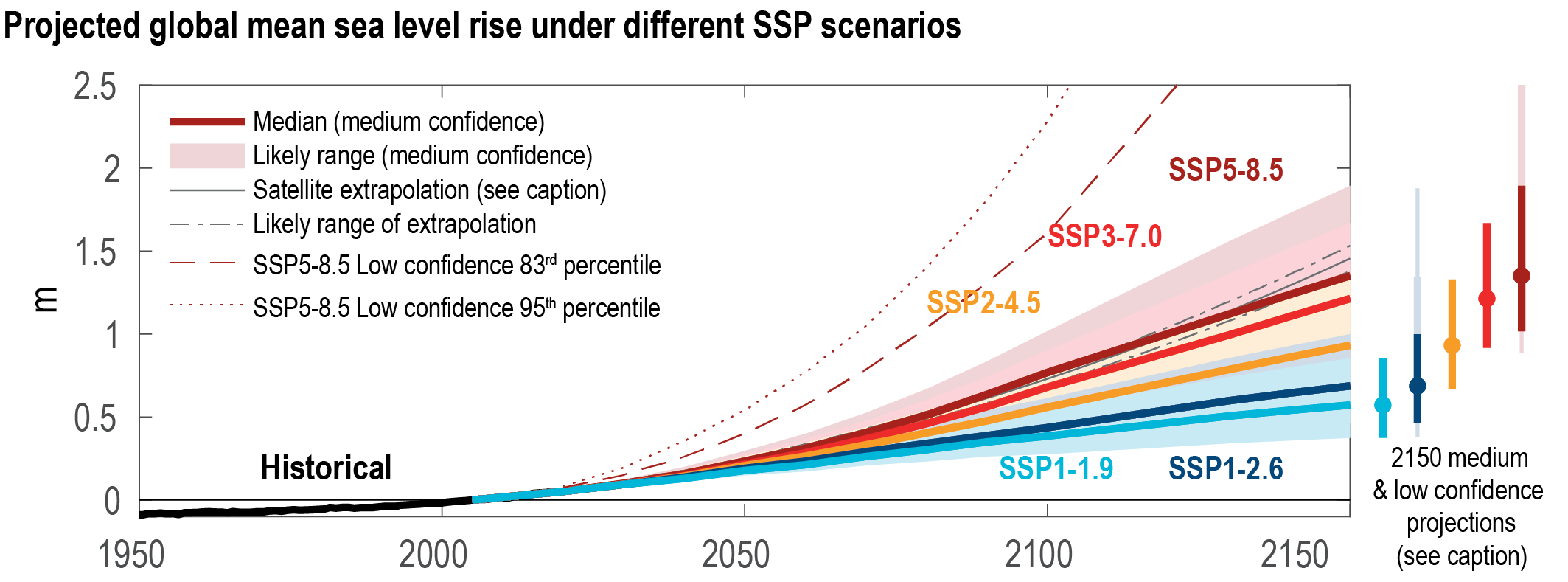
This repository is maintained to manage data related to the Shared Socioeconomic Pathways (SSP) climate scenarios used in climate change projections. It includes code for downloading SSP scenario data via API and visualizing climate variables for each scenario.
The datasets and associated code in this repository are focused on South Korea. For seamless code implementation, the HydroAI library is required. For more detailed information about the HydroAI library, please click here.
What are SSP Scenarios? 1
SSP are future socioeconomic development scenarios used in the IPCC's Sixth Assessment Report to describe various potential futures based on evolving demographics, economies, technologies, and policies.
These scenarios are categorized into five main pathways, from SSP1 (Sustainability) to SSP5 (Fossil-Fueled Development). Each pathway presents a "societal challenge" level, indicating the degree of difficulty in mitigating greenhouse gas emissions and adapting to climate change.
Scientists combine these SSPs with specific greenhouse gas emission levels to create a matrix of scenarios. This framework serves as a critical standard for projecting and evaluating how climate change will vary depending on the trajectory of future societies. By pairing each socioeconomic pathway with a representative emissions scenario, the following futures can be envisioned.
The SSP1-2.6 scenario assumes an optimistic future where the world collaborates toward sustainable development, leading to stable population growth and the widespread adoption of green technologies. This socioeconomic pathway aligns with strong mitigation policies that stabilize radiative forcing at 2.6 W/m² by 2100, a trajectory considered likely to meet the Paris Agreement's 2°C target.
The SSP2-4.5 scenario depicts a "middle of the road" future where current socioeconomic trends continue without significant deviation. This pathway is typically linked to a moderate emissions outcome where climate action is present but insufficient, resulting in radiative forcing reaching approximately 4.5 W/m² by 2100.
The SSP3-7.0 scenario outlines a future of "regional rivalry" where international cooperation collapses and nations prioritize their own security and food production. In such a society, environmental concerns diminish and climate action becomes exceedingly difficult, leading to a high-emissions trajectory with radiative forcing reaching 7.0 W/m² by 2100.
The SSP5-8.5 scenario envisions a future driven by rapid, fossil-fuel-dependent economic growth and a strong belief in technological solutions. This pathway involves immense energy consumption, leading to nearly the maximum possible greenhouse gas emissions. It logically corresponds to a worst-case climate outcome, with radiative forcing reaching 8.5 W/m² by 2100.
Author: Seongjun Lee @ Jun 2024
Footnotes
-
K. Riahi et al., "The Shared Socioeconomic Pathways and their energy, land use, and greenhouse gas emissions implications: An overview," Global Environmental Change, vol. 42, pp. 153–168, 2017/01/01/ 2017, doi: https://doi.org/10.1016/j.gloenvcha.2016.05.009. ↩