





A proc macro framework with templates, composable elements, and built-in diagnostics.
cargo add zynTemplates are fully type-checked at compile time — errors appear inline, just like regular Rust code.
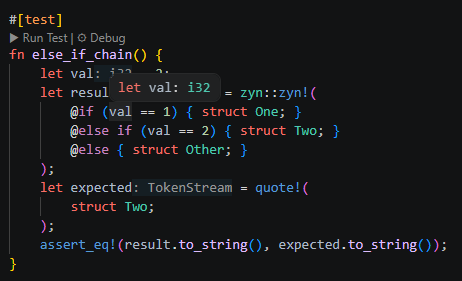
The zyn! macro is the core of zyn. Write token output as if it were source code,
with {{ }} interpolation and @ control flow directives.
Interpolation — any ToTokens value:
let name = zyn::format_ident!("hello_world");
zyn::zyn!(fn {{ name }}() {})
// → fn hello_world() {}
Pipes — transform values inline:
zyn::zyn!(fn {{ name | pascal }}() {})
// name = "hello_world" → fn HelloWorld() {}
Control flow:
zyn::zyn!(
    @if (is_pub) { pub }
    @for (field in fields.named.iter()) {
        fn {{ field.ident }}(&self) -> &{{ field.ty }} {
            &self.{{ field.ident }}
        }
    }
)
Full template syntax:
| Syntax | Purpose |
|---|---|
{{ expr }} |
Interpolate any ToTokens value |
{{ expr | pipe }} |
Transform value through a pipe before inserting |
@if (cond) { ... } |
Conditional token emission |
@else { ... } |
Else branch |
@else if (cond) { ... } |
Else-if branch |
@for (x in iter) { ... } |
Loop over an iterator |
@for (N) { ... } |
Repeat N times |
@match (expr) { pat => { ... } } |
Pattern-based emission |
@element_name(prop = val) |
Invoke a #[element] component |
Elements are reusable template components defined with #[zyn::element].
They encapsulate a fragment of token output and accept typed props.
Define an element:
#[zyn::element]
fn getter(name: zyn::syn::Ident, ty: zyn::syn::Type) -> zyn::TokenStream {
    zyn::zyn! {
        pub fn {{ name | snake | ident:"get_{}" }}(&self) -> &{{ ty }} {
            &self.{{ name }}
        }
    }
}
Invoke it inside any template with @:
zyn::zyn! {
    impl {{ ident }} {
        @for (field in fields.named.iter()) {
            @getter(name = field.ident.clone().unwrap(), ty = field.ty.clone())
        }
    }
}
Elements can also receive extractors — values resolved automatically from proc macro
input — by marking a param with #[zyn(input)]:
#[zyn::derive]
fn my_getters(
    #[zyn(input)] ident: zyn::Extract<zyn::syn::Ident>,
    #[zyn(input)] fields: zyn::Fields<zyn::syn::FieldsNamed>,
) -> zyn::TokenStream {
    zyn::zyn! {
        impl {{ ident }} {
            @for (field in fields.named.iter()) {
                pub fn {{ field.ident | snake | ident:"get_{}" }}(&self) -> &{{ field.ty }} {
                    &self.{{ field.ident }}
                }
            }
        }
    }
}
// Applied to: struct User { first_name: String, age: u32 }
// Generates:
// impl User {
//     pub fn get_first_name(&self) -> &String { &self.first_name }
//     pub fn get_age(&self) -> &u32 { &self.age }
// }
Pipes transform interpolated values: {{ expr | pipe }}. They chain left to right:
zyn::zyn!(fn {{ name | snake | ident:"get_{}" }}() {})
// name = "HelloWorld" → fn get_hello_world() {}
Built-in pipes:
| Pipe | Input example | Output |
|---|---|---|
snake |
HelloWorld |
hello_world |
pascal |
hello_world |
HelloWorld |
camel |
hello_world |
helloWorld |
screaming |
HelloWorld |
HELLO_WORLD |
kebab |
HelloWorld |
"hello-world" |
upper |
hello |
HELLO |
lower |
HELLO |
hello |
str |
hello |
"hello" |
trim |
__foo__ |
foo |
plural |
user |
users |
singular |
users |
user |
ident:"pattern_{}" |
hello |
pattern_hello (ident) |
fmt:"pattern_{}" |
hello |
"pattern_hello" (string) |
Custom pipes via #[zyn::pipe]:
#[zyn::pipe]
fn shout(input: String) -> zyn::syn::Ident {
    zyn::syn::Ident::new(&format!("{}_BANG", input.to_uppercase()), zyn::Span::call_site())
}

zyn::zyn!(fn {{ name | shout }}() {})
// name = "hello" → fn HELLO_BANG() {}zyn provides two tools for attribute handling: a derive macro for typed parsing and a proc macro attribute for writing attribute macros.
Typed attribute structs via #[derive(Attribute)]:
#[derive(zyn::Attribute)]
#[zyn("builder")]
struct BuilderConfig {
    #[zyn(default)]
    skip: bool,
    #[zyn(default = "build".to_string())]
    method: String,
}
// users write: #[builder(skip)] or #[builder(method = "create")]
The derive generates from_args, FromArg, and FromInput implementations, as well as
a human-readable about() string for error messages.
When a user misspells an argument name, zyn automatically suggests the closest known field. No extra setup required:
error: unknown argument `skiip`
  --> src/main.rs:5:12
   |
5  | #[builder(skiip)]
   |           ^^^^^
   |
   = help: did you mean `skip`?
Suggestions are offered when the edit distance is ≤ 3 characters. Distant or completely unknown keys produce only the "unknown argument" error without a suggestion.
Attribute proc macros via #[zyn::attribute]:
#[zyn::attribute]
fn my_attr(#[zyn(input)] item: zyn::syn::ItemFn, args: zyn::Args) -> zyn::TokenStream {
    // args: parsed key=value arguments from the attribute invocation
    zyn::zyn!({ { item } })
}zyn! returns Output — test both tokens and diagnostics directly:
#[test]
fn generates_function() {
    let input: zyn::Input = zyn::parse!("struct Foo;" => zyn::syn::DeriveInput).unwrap().into();
    let output = zyn::zyn!(fn hello() {});
    let expected = zyn::quote::quote!(fn hello() {});
    zyn::assert_tokens!(output, expected);
}
Diagnostic assertions check error messages from error!, warn!, bail!:
#[zyn::element]
fn validated(name: zyn::syn::Ident) -> zyn::TokenStream {
    if name == "forbidden" {
        bail!("reserved identifier `{}`", name);
    }
    zyn::zyn!(fn {{ name }}() {})
}

#[test]
fn rejects_forbidden_name() {
    let input: zyn::Input = zyn::parse!("struct Foo;" => zyn::syn::DeriveInput).unwrap().into();
    let output = zyn::zyn!(@validated(name = zyn::format_ident!("forbidden")));
    zyn::assert_diagnostic_error!(output, "reserved identifier");
    zyn::assert_tokens_empty!(output);
    // ✓ error diagnostic present, no tokens produced
}

#[test]
fn accepts_valid_name() {
    let input: zyn::Input = zyn::parse!("struct Foo;" => zyn::syn::DeriveInput).unwrap().into();
    let output = zyn::zyn!(@validated(name = zyn::format_ident!("hello")));
    zyn::assert_tokens_contain!(output, "fn hello");
    // ✓ tokens contain "fn hello"
}| Macro | Purpose |
|---|---|
assert_tokens! |
Compare two token streams |
assert_tokens_empty! |
Assert no tokens produced |
assert_tokens_contain! |
Check for substring in output |
assert_diagnostic_error! |
Assert error diagnostic with message |
assert_diagnostic_warning! |
Assert warning diagnostic |
assert_diagnostic_note! |
Assert note diagnostic |
assert_diagnostic_help! |
Assert help diagnostic |
assert_compile_error! |
Alias for assert_diagnostic_error! |
With the pretty feature:
| Macro | Purpose |
|---|---|
assert_tokens_pretty! |
Compare using prettyplease-formatted output |
assert_tokens_contain_pretty! |
Substring check on pretty-printed output |
Inspect generated code by adding debug to any zyn attribute macro. Set ZYN_DEBUG to the generated type name (or * for all) to enable output:
#[zyn::element(debug)]
fn greeting(name: zyn::syn::Ident) -> zyn::TokenStream {
    zyn::zyn!(fn {{ name }}() {})
}ZYN_DEBUG="*" cargo buildnote: zyn::element ─── Greeting
fn {{ name }}() {}
--> src/lib.rs:1:1
Without injection, props show as {{ name }} placeholders. With the pretty feature, use debug(pretty) for formatted output:
#[zyn::element(debug(pretty))]
fn greeting(name: zyn::syn::Ident) -> zyn::TokenStream {
    zyn::zyn!(fn {{ name }}() {})
}
note: zyn::element ─── Greeting
fn {{ name }}() {}
--> src/lib.rs:1:1
Use debug(full) to emit the full generated struct + impl instead of just the body. Combine with pretty: debug(pretty, full).
Supply key = "value" injection pairs to substitute static values for props — useful when the real value isn't known at proc-macro time:
#[zyn::element(debug(name = "Foo", ty = "String"))]
fn setter(name: zyn::syn::Ident, ty: zyn::syn::Type) -> zyn::TokenStream {
    zyn::zyn!(fn {{ name }}(value: {{ ty }}) -> Self { self })
}
Output: fn Foo(value : String) -> Self { self }. Without injection, props show as {{ name }}, {{ ty }}.
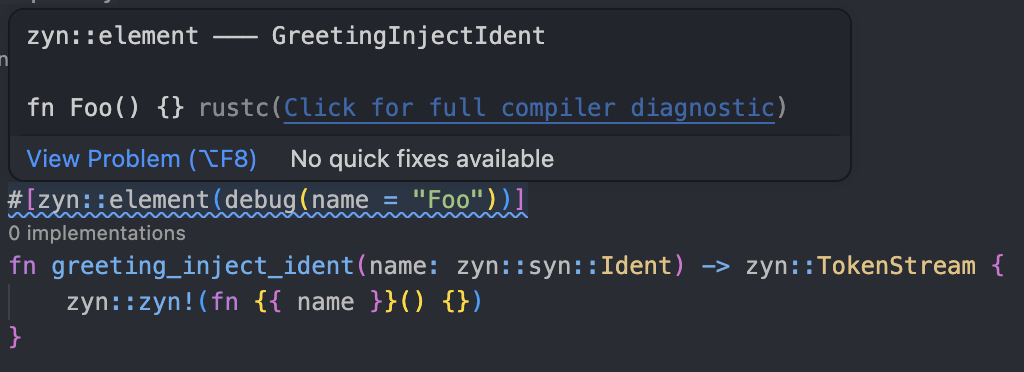
All macros support debug: #[zyn::element], #[zyn::pipe], #[zyn::derive], #[zyn::attribute].
ZYN_DEBUG accepts comma-separated *-wildcard patterns matched against the generated PascalCase type name:
ZYN_DEBUG="Greeting" cargo build        # exact match
ZYN_DEBUG="Greet*" cargo build          # prefix wildcard
ZYN_DEBUG="*Element" cargo build        # suffix wildcard
ZYN_DEBUG="Greeting,Shout" cargo build # multiple patterns| Feature | Default | Description |
|---|---|---|
derive |
✓ | All proc macro attributes: #[element], #[pipe], #[derive], #[attribute], and #[derive(Attribute)] |
ext |
Extension traits for common syn AST types (AttrExt, FieldExt, TypeExt, etc.) |
|
pretty |
Pretty-printed token output in debug mode | |
diagnostics |
Error accumulation — collect multiple errors before aborting |
The ext module adds ergonomic extension traits for navigating syn AST types.
zyn = { features = ["ext"] }use zyn::ext::{AttrExt, TypeExt};
// check and read attribute arguments
if attr.is("serde") {
let rename: Option<_> = attr.get("rename"); // → Some(Meta::NameValue)
let skip: bool = attr.exists("skip");
}
// inspect field types
if field.is_option() {
let inner = field.inner_type().unwrap();
}Pretty-printed debug output and assert_tokens_pretty! / assert_tokens_contain_pretty! assertion macros via prettyplease. See Debugging for usage.
zyn = { features = ["pretty"] }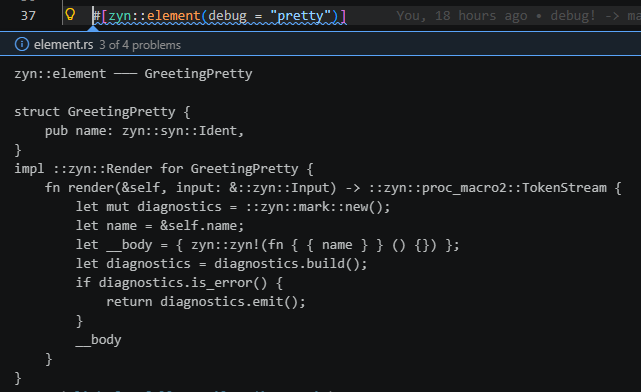
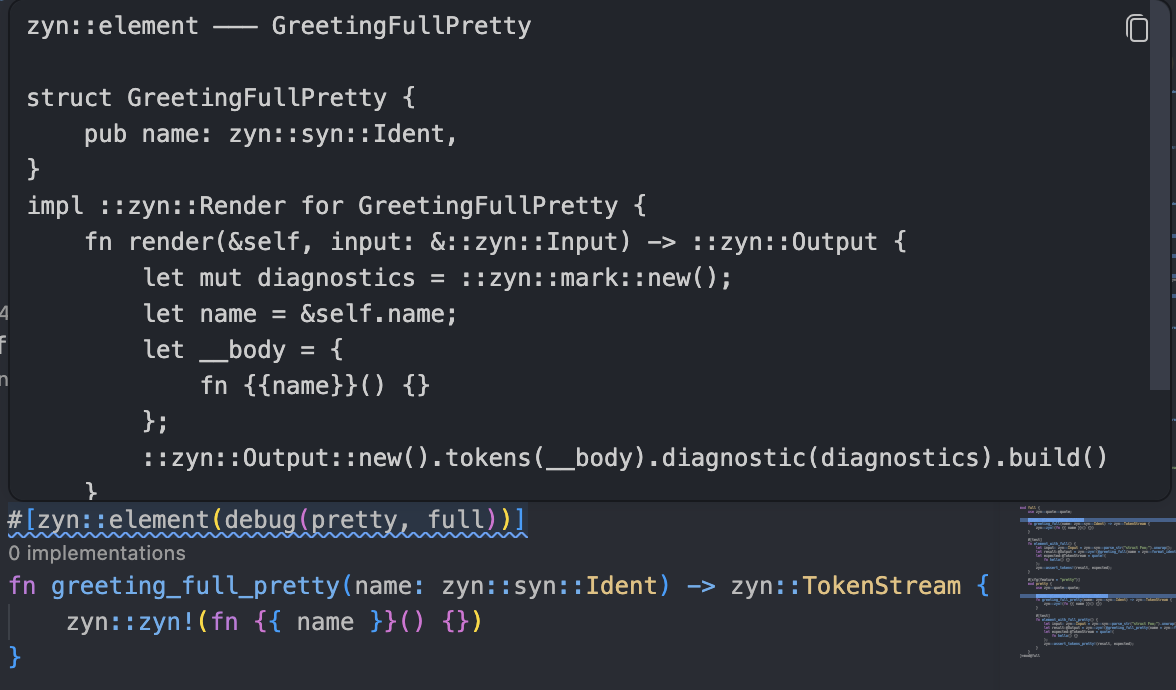
The diagnostics feature enables error accumulation — collecting multiple compiler
errors before aborting, so users see all problems at once instead of one at a time.
zyn = { features = ["diagnostics"] }Inside any #[zyn::element], #[zyn::derive], or #[zyn::attribute] body, use the
built-in diagnostic macros directly — no setup required:
#[zyn::element]
fn my_element(name: zyn::syn::Ident) -> zyn::TokenStream {
    if name == "forbidden" {
        bail!("reserved identifier `{}`", name);
    }

    if name.to_string().starts_with('_') {
        warn!("identifiers starting with `_` are conventionally unused");
    }

    zyn::zyn!(fn {{ name }}() {})
}| Macro | Level | Behaviour |
|---|---|---|
error!(msg) |
error | accumulates, does not stop execution |
warn!(msg) |
warning | accumulates, does not stop execution |
note!(msg) |
note | accumulates, does not stop execution |
help!(msg) |
help | accumulates, does not stop execution |
bail!(msg) |
error | accumulates and immediately returns |
All accumulated diagnostics are emitted together at the end of the element or macro body, so users see every error at once instead of fixing them one by one.
error: reserved identifier `forbidden`
 --> src/main.rs:3:1

error: reserved identifier `forbidden`
 --> src/main.rs:7:1
Benchmarks confirm the zero-overhead claim: the full pipeline (parse, extract, codegen) matches vanilla syn + quote for both structs and enums. Where zyn replaces external crates, it's faster — case conversion is ~6x faster than heck, and attribute parsing is ~14% faster than darling.
Live benchmark charts on bencher.dev
MIT


