[upstream-sync] Merge block/buzz f3519d718..4b3570671 (18 commits, desktop 0.5.10) - #26
Conversation



…olve (block#5245) ## Overview **Category:** fix **User impact:** Link previews no longer disappear when a message is sent while preview metadata or media is still settling. Fast Enter, rapid Enter, and confirmed-draft auto-send now preserve the preview without duplicate sends or stale tags. **Problem:** The composer could look ready before its sender-authored snapshot tag existed. Send paths could then race preview resolution/upload, while debounced preview state could attach a tag for a URL that had already been removed. The same timing also caused confirmed-draft auto-send to be consumed without sending. **Solution:** - Debounce preview resolution to avoid card flicker while typing, then disable every submit path while a supported external preview settles. A 2-second escape cap still permits a bare-link send if resolution stalls. - Keep submit synchronous: acquire a composer-local lock before asynchronous send work, read ready tags from the live URL set, and reject Enter/form submits while a snapshot is pending. - Retry confirmed-draft auto-submit until preview settling clears, then submit exactly once. - Upload thumbnail and favicon independently. A failed upload shows a toast and degrades to the surviving media (or text-only) rather than leaving the card spinning. - Exclude message-edit mode from preview resolution, upload, and Save gating. Edit-time preview snapshots remain follow-up block#5273. - Canonicalize fragment-bearing URLs for preview lookup/snapshot identity while preserving the original fragment links in message text. ## Link preview state walkthrough Captured using PR block#5245's actual public Open Graph metadata and artwork. The deterministic E2E bridge controls only upload timing so the transient disabled state can be captured reliably. | State | Expected behavior | Screenshot | | --- | --- | --- | | **1. Snapshot upload pending** | The real PR preview is visible, but Submit remains disabled until its sendable snapshot tag is ready. Click and Enter cannot send a bare link during the settling window. | 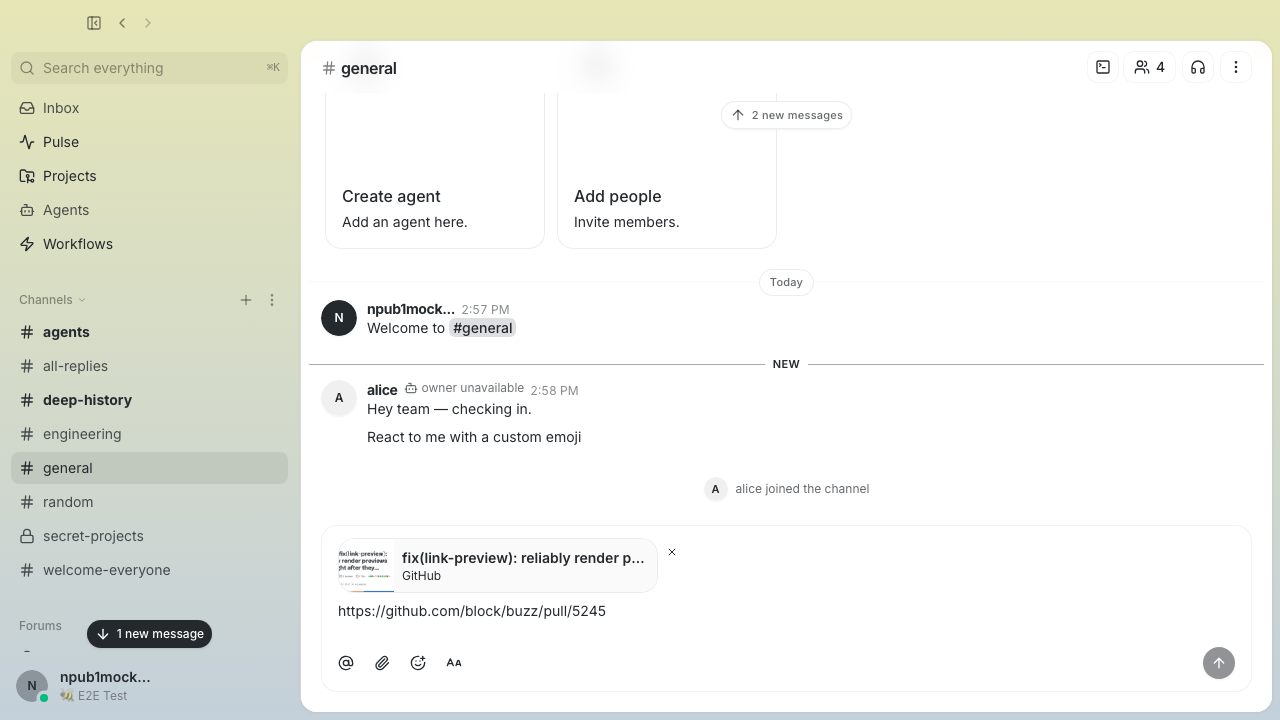 | | **2. Snapshot ready** | Once snapshot upload settles and the tag is ready, the same preview remains and Submit becomes active. | 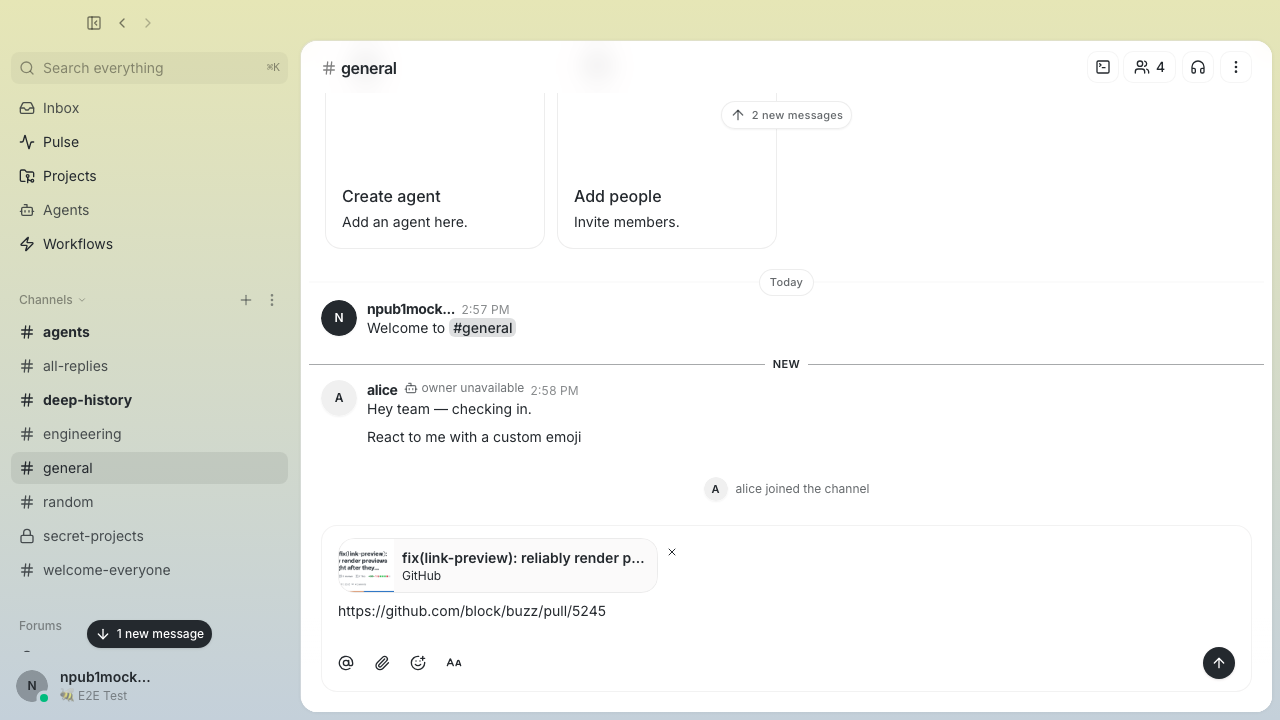 | | **3. Message sent** | The sent event carries the snapshot tag and renders the PR title, description, and artwork inline instead of degrading to a bare URL. | 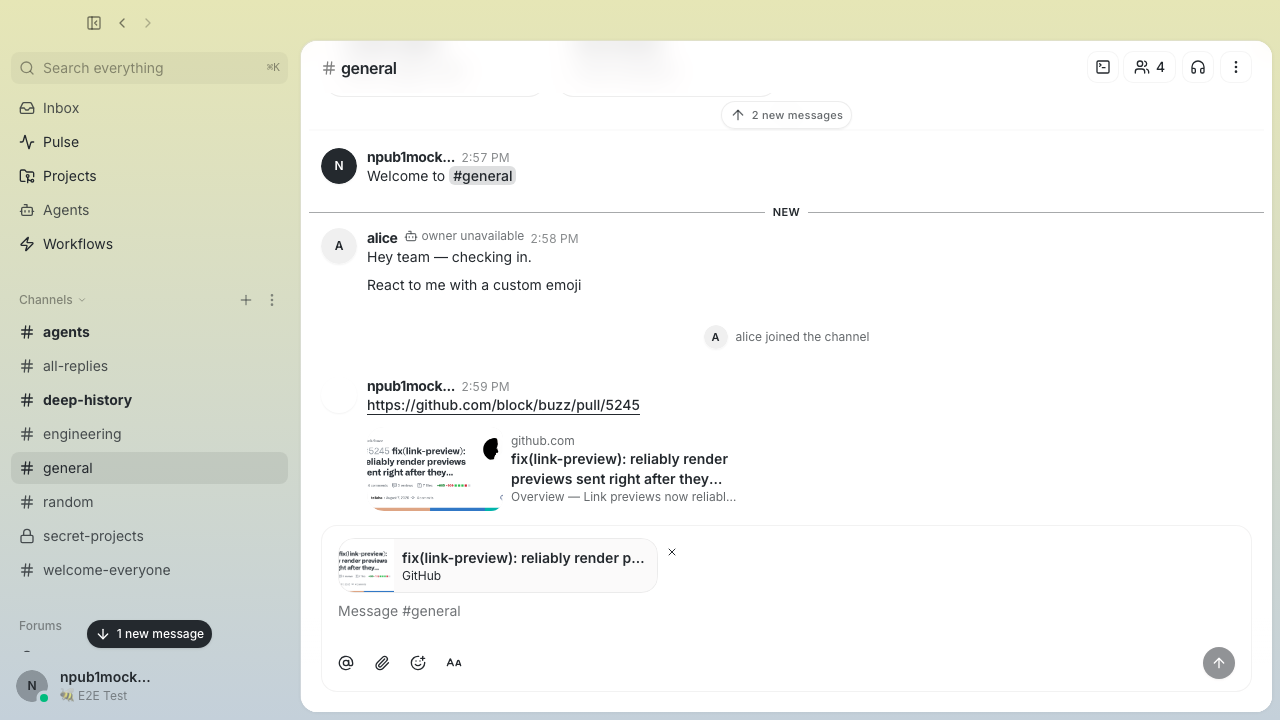 | ## Regression coverage - Enter during metadata resolution or snapshot upload cannot send early. - Paste-and-immediate-Enter sends after settling; rapid Enter submits exactly once. - Confirmed-draft auto-send waits for settling and fires exactly once. - Removed/replaced URLs cannot leak stale snapshot tags or media refs. - Thumbnail upload failure toasts and sends with the surviving favicon. - Edit mode does not resolve/upload previews or gate Save. - Fragment variants share a canonical preview while original fragment links remain clickable. - Existing ready-preview, suppression, bare-link fallback, and multi-preview behavior remains covered. ## Reproduction steps 1. Open a channel and paste a supported external URL into the composer. 2. Press Enter immediately, before preview metadata/media finishes settling. 3. Before this fix, the event could be sent without its preview snapshot (or confirmed-draft auto-send could be lost). With this fix, submit waits behind the disabled state and fires once with the matching snapshot tag. 4. Remove or replace the URL and press Enter inside the debounce window. The sent event contains tags only for URLs still present in the submitted content. ## Validation All required PR checks are green, including Desktop Core, Desktop Smoke E2E shards, Desktop E2E Integration shards, macOS build, security checks, and DCO. --------- Signed-off-by: Taylor Ho <taylorkmho@gmail.com> Signed-off-by: Wes <wesbillman@users.noreply.github.com> Co-authored-by: Wes <wesbillman@users.noreply.github.com> Co-authored-by: Carl <c7ebe626f000404285d3686e1dc74cc07cc60a9754a150041ba132e14bd3e2ec@buzz.block.builderlab.xyz>

…ock#5534)

Hardens the Databricks PKCE OAuth code in
`crates/buzz-agent/src/auth.rs`. Two fixes.

## Token cache is owner-only across its whole lifecycle, and race-safe

The PKCE cache holds both the access and refresh tokens, but `save()`
wrote it with a bare `fs::write` + `fs::rename`. Under a `022` umask the
file landed world-readable, and the fixed `*.json.tmp` temp name races
across concurrent savers sharing `$HOME` — one writer's `rename` can
fail on another's half-written temp.

**On write**, `write_private_cache()` creates a temp file with
owner-only permissions from the moment it exists — mode `0o600` on Unix
via `OpenOptions::mode` — writes and fsyncs it, then renames over the
destination. The rename swaps the inode wholesale, so a pre-existing
cache file with loose permissions is *replaced* by the new private inode
rather than inheriting its mode. `unique_suffix()` (getrandom, timestamp
fallback) gives each write a distinct temp name, and a drop guard
removes the temp on any failure path.

**On load**, owner-only is enforced as a cache lifecycle invariant, not
just a write-path property. A world-readable cache left by an older
buzz-agent was previously read straight into memory and returned on the
fresh cache-hit path without ever invoking `save()`, so a token file
with no advertised expiry could stay exposed indefinitely.
`read_cache()` now funnels every load — initial and cross-process
re-reads — through `read_private_cache()`, which on Unix opens with
`O_NOFOLLOW` (kernel-level symlink refusal, no stat/open TOCTOU),
requires a regular file, and `fchmod`s the pinned handle to `0o600` when
any group/other bit is set. A cache that cannot be secured is treated as
absent, so callers fail closed to a fresh flow rather than trusting an
exposed file.

## OAuth callback no longer reflects untrusted input

The localhost callback embedded the untrusted `error` query param
straight into the HTML response — an XSS sink on the redirect page — and
routed that same raw value into the error string that reaches the logs.

`callback_outcome()` is now a pure function returning `(result,
static_page)`: the browser always sees a fixed literal page that embeds
no request parameter, and failure detail travels only through the result
channel. `sanitize_callback_detail()` strips control characters (CR/LF
log-line injection) and caps length before that detail enters the error
string bound for the logs.

## Deferred: Windows owner-only ACLs

Windows owner-only protection is out of scope for this change. The
goose-parity route (`CreateFileW` with an owner-only SDDL
`D:P(A;;FA;;;OW)`) requires `unsafe` FFI, which this crate's
`#![forbid(unsafe_code)]` prohibits; reconciling that conflict is a
separate decision. Both platform seams — `create_private_temp_file`
(write) and `read_private_cache` (load) — have a `#[cfg(not(unix))]`
branch that relies on the default per-user ACLs and is the drop-in point
if Windows protection is added later. No new dependency and no `unsafe`
are introduced here.

---------

Signed-off-by: Will Pfleger <pfleger.will@gmail.com>
Co-authored-by: Hayt <41ea58f1e64c243627e8acde7c89be667052ee6e17d8f021c1195be4324ebf04@buzz.block.builderlab.xyz>
**Category:** fix
**User Impact:** YouTube video links now resolve into reliable previews
instead of intermittently appearing as bare links.

**Problem:** Buzz intentionally reads at most **256 KiB** of page HTML
when building a generic link preview. The YouTube response that exposed
this bug was roughly **1.3 MiB**, with its Open Graph metadata beginning
around **686 KiB**—well beyond Buzz's bounded read—so extraction
returned no usable preview. YouTube can move that metadata between
responses, which explains why the same link may appear to work in one
build or request and fail in another; raising the generic cap would
increase bandwidth and allocation for every site while still scraping an
unstable application document.

**Solution:** Route recognized YouTube video URLs through YouTube's
structured oEmbed endpoint instead of parsing raw watch-page HTML. The
provider response is capped at **64 KiB** and retains Buzz's existing
HTTPS validation, pinned DNS/SSRF protection, disabled redirects,
timeouts, metadata bounds, and thumbnail sanitization. Provider failures
return no preview rather than falling back to fragile HTML scraping, and
embed URLs are canonicalized safely, including percent-encoded video
IDs.

<details>
<summary>File changes</summary>

**desktop/src-tauri/src/commands/link_preview.rs**
Recognizes supported YouTube URL forms, fetches bounded JSON metadata
from YouTube oEmbed, canonicalizes embed links, and adds response,
URL-boundary, malformed-data, resource-limit, and encoded-ID
regressions.

**desktop/src-tauri/Cargo.toml**
Declares percent decoding as a direct desktop dependency for safe
embed-ID canonicalization.

**desktop/src-tauri/Cargo.lock**
Records the direct dependency in the desktop package lock entry.

</details>

## Reproduction Steps

1. On the base branch, paste a YouTube URL whose Open Graph metadata
falls beyond the first 256 KiB of the raw watch-page response and
observe that no preview is produced.
2. Run this branch and paste a YouTube watch, mobile, music, `youtu.be`,
Shorts, live, or embed URL into the composer.
3. Confirm the preview resolves with the video's title, creator, and
sanitized thumbnail without downloading the full watch-page HTML.
4. Try an embed URL with a percent-encoded ID, such as
`https://www.youtube.com/embed/%64Qw4w9WgXcQ`, and confirm it resolves
to the same video.
5. Try a YouTube lookalike domain or an embed ID containing encoded
separators and confirm it is not routed through the provider path.

---------

Signed-off-by: Taylor Ho <taylorkmho@gmail.com>
**Category:** fix
**User Impact:** Previously selected community themes are preserved when
opening a relay through onboarding, while first-time theme migration
still completes for communities with no saved theme.

**Problem:** During community initialization, desktop queried theme
history before establishing live delivery. If a replacement event
arrived while an empty history query was in flight, the client could
incorrectly treat the theme as absent and publish the default over the
user's saved selection.

**Solution:** Subscribe before fetching history, expose whether live
readiness reached EOSE, flush buffered live events before resolving
EOSE, and retain the newest delivered replacement through hydration.
Seed the inherited/default theme only when both live and history
snapshots reach EOSE with no valid or unreadable event; subscription
failures, CLOSED, readiness timeout, relay failure, and unreadable
events fail closed without publishing.

<details>
<summary>File changes</summary>

**desktop/src/shared/api/relayClientSession.ts / relayClientShared.ts /
relayClosedRecovery.ts**
Distinguish EOSE from CLOSED/timeout readiness and flush buffered events
before resolving an EOSE fence.

**desktop/src/shared/theme/CommunityThemeController.tsx**
Seed and complete first-community migration only for confirmed absence;
uncertain hydration remains non-publishing.

**desktop/src/shared/theme/communityThemePreference.ts**
Keep the inherited appearance for the first migrated community and the
stable default for later empty communities.

**desktop/src/shared/theme/communityThemeSync.ts**
Arbitrate live and history results into valid, confirmed-absent,
invalid, or unavailable hydration outcomes.

**Tests**
Cover EOSE/CLOSED readiness, subscription failure, timeout, unreadable
and live-racing events, no-op initialization, and first-to-later
community fallback isolation.

</details>

## Reproduction steps

1. Save a non-default appearance for a community relay.
2. Remove the community locally, then open the same relay again through
onboarding.
3. Arrange for the saved replacement event to arrive live while the
initial history query returns empty.
4. Confirm the saved appearance remains selected and the client does not
publish the default theme over it.
5. On an account with no theme records, open a first empty community and
confirm its inherited appearance is migrated; open a later empty
community and confirm it starts from the stable default.

## Validation

- Pre-push desktop checks, typecheck, and full desktop tests: passed at
`f79556b0e`
- Focused theme/relay readiness tests: 38 passed
- Desktop file-size ratchet and diff check: passed

---------

Signed-off-by: Taylor Ho <taylorkmho@gmail.com>
Signed-off-by: Carl <acda9e433d19dcd0e6b6840f7f4b98f3a56f1fab98049d444c087019e6d36560@buzz.block.builderlab.xyz>
Co-authored-by: Carl <acda9e433d19dcd0e6b6840f7f4b98f3a56f1fab98049d444c087019e6d36560@buzz.block.builderlab.xyz>


…l selection for mesh (block#5289)

Shared compute now has exactly two model choices: MeshLLM's virtual
`mesh`
model, or a model you name. Buzz picks between them in one place, and
buzz-agent no longer knows meshes exist.

## What changed

- **MeshLLM v0.74.0 → v0.75.1.** v0.75.0 added
`degrade_to_single_model`, so a
  `model=mesh` request is answered by one served model when there is no
committee to form, instead of failing. v0.75.1 adds Mesh-LLM#1196, which
skips stale pre-0.75 runtime cache entries rather than aborting startup
on
them — without it, anyone who had run mesh on 0.73/0.74 could not start.
- **Deleted the client-side mesh catalog probe.** buzz-agent used to
poll
`/v1/models` (5s TTL, 30s cooldown, two-observation debounce) to decide
whether `mesh` was safe to send. MeshLLM now decides per request, so the
  polling, its hysteresis, and its 503 fallback are gone.
- **One mapping point.** `relay_mesh_wire_model()` turns the stored
value into
a wire name: `auto` becomes `mesh`, a named model passes through. The
spawn
env, the ACP harness, and the readiness probe all use it, so they cannot
disagree — previously `BUZZ_ACP_MODEL` and the probe both said `auto`, a
name
  the mesh does not advertise.
- **Removed the `nostr-relay-pool` advisory exception.** block#5404 allowed
RUSTSEC-2026-0243 "after mesh-llm migrates to nostr-sdk >= 0.45".
v0.75.1
does, so the retired crate is gone from both lockfiles and the exception
  would only mask a future advisory for it.
- **Deleted `scripts/ensure-mesh-native-runtime.sh`** and its six
justfile call
sites. It built llama.cpp from source into the runtime cache; the app
already
  downloads the signed release runtime itself, and CI never called it.

## Why it is better

**−639 lines of Rust.** Availability is decided by the node that knows
the
answer, per request, instead of by a client cache that could be stale
for up to
30 seconds. A second worker joining now takes effect on the next request
rather
than after two confirming probes.

## Behaviour change

A 503 on an explicit `mesh` request takes the ordinary transport retry
under
the same model instead of failing over to a second one — there is no
second
model to fail over to now. MoA repairs partial committee results
internally
before it reaches that point.

## Validation

`crates/buzz-relay/examples/mesh_agent_e2e.rs` now sends `mesh` where it
previously sent `auto` or the physical model id, so no leg was covering
what
Buzz actually puts on the wire. 4/4 on gemma-4-E4B, gemma-4-26B-A4B, and
Qwen3-8B — including a real ACP tool call through `mesh` into
buzz-dev-mcp,
asserted by reading the written file back off disk.

Hand-tested in the desktop app on both gemma-4 sizes: picked Auto, agent
logged
`model_id=mesh`, replied in channel.

## Not covered

A committee that forms and then loses a worker returns 502, and that
needs two
workers to reproduce — not testable on one machine.

---------

Signed-off-by: Michael Neale <michael.neale@gmail.com>
Co-authored-by: Michael Neale <michael.neale@gmail.com>
…home-feed (block#5535)

Fixes the 0.5.9 sluggishness Wes reported in app-slowness-mac (channel
list slow, content slow).

## Problem

block#5490 (shipped in 0.5.9) flipped ~20 query sites to
`refetchOnWindowFocus: true` and wired TanStack focusManager to app
focus. Instrumented at that exact commit: regaining focus after >60s
away fires **7 query fetches within 2ms**, including `get_channels`,
which settles at **~3.6s** (production probe: median 3.2s at 1,133
channels — 8 serial round-trips, 1,133-filter last-message batch). In
0.5.8 this burst was zero by configuration. Net: a burst of fetch/parse
contention exactly when the user returns to the app.

Relay ruled out: v0.2.1 small reads are 2–4ms upstream; nothing in
v0.2.0..v0.2.1 degrades the query path. The O(N) `get_channels` design
is a pre-existing issue (June analysis) — this PR fixes the new stampede
that made it user-visible.

## Fix

Raise `staleTime` to 5 minutes on the two expensive focus-refetch
families — `channels` and `home-feed` — so a focus return inside that
window serves cache instead of refetching. `refetchOnWindowFocus: true`
only refetches stale queries, so genuinely old data still refreshes on
return.

Unchanged: focused polling cadence (60s channels / 30s home-feed;
interval refetches ignore staleTime), block#5490 blur quiescence (no changes
to `useDocumentVisible.ts`/`queryClient.ts`), all push-style
invalidation paths (`invalidateQueries` bypasses staleTime), and
channels cold-start revalidate (`initialDataUpdatedAt: 0`).

## Validation

- New regression test
`desktop/src/features/home/focusRefetchPolicy.test.mjs` (4/4): fresh
focus return → 0 fetches; stale → 1; polling constants locked.
- Pre-push gate at the reviewed tree: desktop-check, desktop-typecheck,
full desktop-test **4588/4588**.
- Independent adversarial review (Beth): APPROVE at tree `4e2546ec` —
verified fresh-skip/stale-refetch against query-core 5.100.14 source,
polling-cadence via browser-simulated probe, side-effect sweep of all
invalidation paths clean. Sole CHANGE was commit trailers, fixed by
amend (tree unchanged).

## Known residual

Focus returns after >5min still fire the full burst including the
~3.2–3.6s `get_channels`. This cuts stampede frequency, not magnitude —
the O(N) `get_channels` relay path (RESEARCH/GET_CHANNELS_SLOWNESS.md)
is the follow-up that fixes magnitude.

Diagnosis: Summer (focus profiling) + Morty (relay probe); implemented
by Meeseeks; reviewed by Beth; integrated by Rick. Thread:
app-slowness-mac
e78fad29380d9a0974c9d673910450994a228781ddce133a8cedbd90504d95be.

Signed-off-by: Wes <wesbillman@users.noreply.github.com>
Co-authored-by: Meeseeks <2e96988f190ed1bd3c568760103aa4cadb2bc6195b832e252c984392c89039bd@buzz.block.builderlab.xyz>
## Summary

- skip the channel subscription catch-up request when the authoritative
channel window was fetched successfully within the existing five-minute
freshness period
- keep the responsive deferred skeleton for populated channel switches
instead of briefly rendering empty-channel actions
- preserve a real empty-channel intro across the first appended message
only after React has committed that empty state

This is intentionally narrow. It does not claim to solve the separate
sidebar startup cost or general main-thread stalls found during the
investigation.

### Related issue

N/A — no matching open issue or PR found.

### Testing

- pre-push desktop gate on `f1be6beea90b9715e04e5fc65cc5cfbe8210e0d9`:
  - desktop tests: 4,621 passed
  - desktop check: passed
  - desktop typecheck: passed
  - branch-skew: passed
- focused cache/surface/lifecycle tests: 62 passed
- manual diagnostic trace after rollback:
  - 16/16 channel revisits skipped catch-up refresh
  - 0 revisit refresh starts
  - 0 populated-channel empty/intro flashes
  - cached switches retained the deferred skeleton-to-list path

No screenshot: the regression is a transient channel-switch state and
request behavior, covered by lifecycle tests and the diagnostic trace
rather than a stable visual diff.

Signed-off-by: Wes <wesbillman@users.noreply.github.com>
Co-authored-by: Carl <c7ebe626f000404285d3686e1dc74cc07cc60a9754a150041ba132e14bd3e2ec@buzz.block.builderlab.xyz>
…lock#5569)

## Problem

Canceling the native macOS file chooser leaves the composer's temporary,
detached `<input type="file">` without a `change` event or an explicit
cleanup path. Opening Finder again immediately creates a second detached
input while WebKit may still be unwinding the first picker. The newly
selected files can therefore fail to reach the upload pipeline. Drag and
drop is unaffected because it bypasses this picker lifecycle.

This does **not** add an automatic retry mechanism. “Retry” means the
user's next attachment attempt after canceling or after a prior
selection.

## Fix

- give each composer hook one hidden, body-mounted file input for its
lifetime instead of creating a detached one per click
- reset and reconfigure that input before every open, replace its
handler rather than stacking handlers, and remove it cleanly on unmount
- preserve normal selection, cancel then reopen, selecting the same file
again, and multi-select behavior
- accept canonical `text/html` attachments while continuing to serve and
render them strictly as inert downloads
- keep XHTML, SVG, JavaScript, and executable MIME types blocked

The picker change fixes the ownership/lifecycle bug at its source; it
does not retry failed uploads, add delays, or mask errors.

## Testing

- mandatory pre-push gate: branch-skew, desktop typecheck/tests/check,
Rust tests, and desktop Tauri checks passed on
`ea5a97adf957803935b28d63d32f9f332cf65287`
- `cargo test -p buzz-media --lib` (110 passed)
- `pnpm --dir desktop typecheck`
- focused Biome check for the three picker files
- picker Playwright regression: cancel/no selection then reopen, select
the same file again, and multiple selection (run on the source commit
before integration)
- HTML live-relay response regression added as ignored E2E because it
requires the S3-backed relay harness

## Manual verification

Playwright models cancellation with Chromium's
`FileChooser.setFiles([])`; it cannot exercise the native macOS Finder
panel/WebKit presentation lifecycle. Before merge, manually verify in
the built macOS app:

1. select a PNG normally
2. cancel, then immediately reopen and select a PNG
3. select the same PNG on a subsequent attempt
4. multi-select two PNGs

---------

Signed-off-by: Wes <wesbillman@users.noreply.github.com>
Co-authored-by: Princess Donut <68157ebd23b3897c1991015c3038658ea916200c67d3a54620b0754d1b92f6e0@buzz.block.builderlab.xyz>
Co-authored-by: Mongo <5c25403eab7271f9f94ddd4f2b270e8cac2c92e2c830c51877cca6ec974ffb3f@buzz.block.builderlab.xyz>
Co-authored-by: Carl <c7ebe626f000404285d3686e1dc74cc07cc60a9754a150041ba132e14bd3e2ec@buzz.block.builderlab.xyz>

## Summary

- Share eligible self-authored or owned-agent thread messages into the
parent channel as new top-level messages.
- Link the shared message back to the exact root thread with a semantic
channel label and excerpt.
- Add a dedicated channel-arrow icon plus ownership and navigation
coverage.

## Validation

- Desktop lint, size, and text guards
- Desktop TypeScript build and all 4,543 unit tests
- Focused Playwright send-to-channel and thread-link navigation tests

---------

Signed-off-by: kenny lopez <klopez4212@gmail.com>
Signed-off-by: Kenny Lopez <klopez4212@gmail.com>
Signed-off-by: Wes <wesbillman@users.noreply.github.com>
Co-authored-by: Carl <3c4caeafb646d23867f1c4832e68211d77e2561946171625f75c3ce1a3f2670f@buzz.block.builderlab.xyz>
Co-authored-by: Princess Donut <b238ea756dee4d98afa5883fc7f1de61eeabe65bf700e3a5a5a80db5e42e2c2b@buzz.block.builderlab.xyz>
Co-authored-by: Fast Fizz <2df81cb51f05a9d5387ef24d7b9ecb8fcdfcd1c70ffabc67061c9596e1b5b1c4@buzz.block.builderlab.xyz>
Co-authored-by: Wes <wesbillman@users.noreply.github.com>
Co-authored-by: Carl <c7ebe626f000404285d3686e1dc74cc07cc60a9754a150041ba132e14bd3e2ec@buzz.block.builderlab.xyz>
## Summary

- add an opt-in native glass sidebar with opacity controls and live
theme previews
- refine sidebar spacing and Buzz-only active rows while preserving
production defaults
- unify settings section cards, subtitles, and agent runtime rows

## Validation

- repository format, lint, type, and file-size checks
- 4,538 desktop tests and 2,270 native desktop tests
- desktop and web production builds
- 1,261 mobile tests in the completed full gate
- focused Playwright appearance, sidebar, settings, pairing, and runtime
coverage

---------

Signed-off-by: kenny lopez <klopez4212@gmail.com>
Signed-off-by: Kenny Lopez <klopez4212@gmail.com>
Signed-off-by: Wes <wesbillman@users.noreply.github.com>
Signed-off-by: Fast Fizz <2df81cb51f05a9d5387ef24d7b9ecb8fcdfcd1c70ffabc67061c9596e1b5b1c4@buzz.block.builderlab.xyz>
Co-authored-by: Carl <3c4caeafb646d23867f1c4832e68211d77e2561946171625f75c3ce1a3f2670f@buzz.block.builderlab.xyz>
Co-authored-by: Wes <wesbillman@users.noreply.github.com>
Co-authored-by: Carl <c7ebe626f000404285d3686e1dc74cc07cc60a9754a150041ba132e14bd3e2ec@buzz.block.builderlab.xyz>
Co-authored-by: Fast Fizz <2df81cb51f05a9d5387ef24d7b9ecb8fcdfcd1c70ffabc67061c9596e1b5b1c4@buzz.block.builderlab.xyz>
## What changed

- unify Cmd+K and channel Cmd+F around a removable channel or
conversation scope
- add conservative fuzzy matching for people and channels while
preserving exact-match ordering
- make scoped message search complete for one-character queries and
expose up to 40 scrollable results
- keep the pre-scope channel or DM action in the normal results flow so
it scrolls away with the list

## Validation

- desktop TypeScript typecheck
- desktop text-size and file-size guards
- focused fuzzy-search unit tests (24 passed)
- focused search Playwright coverage (7 passed), including channel and
DM copy, one-character results/no-results, 40-result scrolling, and the
non-sticky scope action
- desktop E2E build
- visual review of channel, scoped, expanded-results, and DM states

---------

Signed-off-by: kenny lopez <klopez4212@gmail.com>
Co-authored-by: Carl <3c4caeafb646d23867f1c4832e68211d77e2561946171625f75c3ce1a3f2670f@buzz.block.builderlab.xyz>


## Why
Expose PostgreSQL datastore latency within existing request traces so
slow logical database operations can be identified without recording
tenant data or query arguments.

## What
- Add client spans around logical PostgreSQL operations across the
database facade, search, audit, replica fencing, and command persistence
- Use a dedicated `buzz_datastore` target and `db.system.name =
"postgresql"` for filtering and backend classification
- Exclude health-check database calls and scrub raw identifiers and
errors from newly traced paths

## Risk Assessment
Medium — this instruments frequently used datastore paths and increases
trace volume when enabled, but does not change SQL execution or
datastore behavior. Existing OpenTelemetry filtering controls export.

## References
- Pre-push clippy and fast unit-test hooks passed

Generated with Amp

---------

Signed-off-by: David Grochowski <dgrochowski@squareup.com>
Co-authored-by: Amp <amp@ampcode.com>

The HTTP bridge request log recorded route, status, and accepted but not
the event kind, so typing indicators (kind 7) and their deletions (kind
5)
were indistinguishable from real messages (kind 9). Every agent turn
produced
accepted:true lines whether or not a message was actually sent, which
twice
led debuggers to conclude a silent agent had published successfully.

Add kind to the Ok outcome and the tracing::info line so the publish
path is
self-describing without a database query.

Closes block#4676

Signed-off-by: Taksh <takshkothari09@gmail.com>
## Summary

- let Virtua own the initial visible timeline range instead of passing
every loaded row to `keepMounted`
- populate the existing bounded retention window after the virtualizer
reports its first settled viewport
- cover a 10,000-row timeline to prevent an all-history initial mount
regression

## Why

`useTimelineRetention` initialized its retained-key set with every
loaded timeline key. Those indices were passed to Virtua's
`keepMounted`, effectively defeating virtualization during initial
channel positioning until `onScrollEnd` pruned the set.

On a large real channel this grew WebContent into multiple gigabytes and
blocked the renderer main thread for 20+ seconds while WebKit laid out
and painted the retained rows. Starting with no retained rows restores
Virtua's visible-range mount; the existing reader-neighborhood and
visual-tail retention is populated once the viewport is measured.

## Validation

- `node --import ./test-loader.mjs --experimental-strip-types --test
src/features/messages/ui/useTimelineRetention.test.mjs`
- pre-push hook at `8e86a189de7e9a8f2cb119396c8f912ed9dacd6e`:
branch-skew, desktop-check, desktop-typecheck, and all 4,671 desktop
tests passed
- manual ablation against PR block#5599 on the affected profile: catastrophic
channel-switch stalls disappeared

## Authorship disclosure

Carl implemented and is posting this change on Wes's behalf.

---------

Signed-off-by: Wes <wesbillman@users.noreply.github.com>
Co-authored-by: Carl <c7ebe626f000404285d3686e1dc74cc07cc60a9754a150041ba132e14bd3e2ec@buzz.block.builderlab.xyz>
…events (block#5294)

A NIP-25 reaction whose target is a project root or project comment
(kind
1621 issue, 1618 PR, or a kind-1 comment on one) carries no h tag, so
channel_id is None on the reaction write path. The conformance-trace
emission asserted a channel was always present:

channel: channel_label(channel_id.expect("reaction path has channel")),

so the worker panicked at ingest.rs:2824. The row was inserted before
the
panic, so the client saw a failed request for a persisted event and
retried,
and the duplicate branch carried the same expect, head-of-line blocking
a
durable publish queue forever.

Mirror the message write's three-way split at the same seam:
(Some, true) -> WriteInsert, (Some, false) -> WriteDuplicate, (None, _)
-> WriteInsertGlobal. The conformance vocabulary already models
channel-less
writes; only the reaction path was missing it.

Closes block#4936

Signed-off-by: Taksh <takshkothari09@gmail.com>
Signed-off-by: Ravneet Arora <rarora@squareup.com>
Follow-on to block#5453/block#5454's localStorage work — found while investigating
app-slowness reports on a real profile.

## Problem

`ReadStateManager.persistLocalState()` serialized and rewrote **all
three** read-state localStorage blobs (`buzz.channel-read-state.v2`,
`.publishable.v1`, `.source-created-at.v1`) synchronously on every
context advance. On a real profile (1,643 contexts, ~450K chars across
the three blobs) this produced ~880KB of localStorage sqlite WAL growth
per 30 seconds at idle, with writes every ~5s — steady main-thread
serialization + sync IPC for no user-visible benefit. Observed WAL size
on the affected profile: 94–114MB.

## Fix

- Local persistence coalesced behind a **1s trailing-edge timer**: a
burst of N advances produces one `writeStoredReadState` (one write per
blob).
- Pending dirty state **flushes synchronously** on `pagehide`, hidden
`visibilitychange`, `destroy()`, and before each relay publish — disk is
current before any relay event goes out.
- Hydration still persists immediately. Publish debounce (5s), merge
logic, and blob formats unchanged (`DEBOUNCE_MS` renamed to
`PUBLISH_DEBOUNCE_MS` only).

## Accepted residual

A hard kill (SIGKILL/power loss — not webview teardown) inside the 1s
window loses ≤1s of local read-state advances; relay max-merge bounds
the effect to a message flickering back unread. On the record per
review.

## Validation

- `readStateManager.test.mjs`: fake-timer/mock-storage coverage —
exactly one 3-blob write per burst (zero before the timer fires),
hidden-flush cancels the timer and persists, hydrate persists
immediately, pre-publish flush. Suite 26/26.
- Push gate at the pushed commit: desktop check, typecheck, full desktop
unit suite 4,670/4,670.
- Independent adversarial FULL REVIEW: **APPROVE** at tree `371a02cf`
(commit metadata rewritten afterward for attribution; tree identical) —
all six `persistLocalState` call sites traced, lifecycle/leak checks
(StrictMode remount, pubkey change), no external readers of the blob
keys.

---------

Signed-off-by: Wes <wesbillman@users.noreply.github.com>
Co-authored-by: Meeseeks <2e96988f190ed1bd3c568760103aa4cadb2bc6195b832e252c984392c89039bd@buzz.block.builderlab.xyz>
Co-authored-by: Carl <c7ebe626f000404285d3686e1dc74cc07cc60a9754a150041ba132e14bd3e2ec@buzz.block.builderlab.xyz>
…lock#5599)

Desktop input latency regressed sharply for users on v0.5.9 and worsened
on latest main: multi-second stalls when clicking back into the app,
slow fresh boots, intermittent lockups, and scroll/mouse degradation.
Reverting to `119a84897` (pre-0.5.9) was confirmed to resolve it,
isolating the regression to that range. Profiling a live production
renderer plus a commit-level audit of the range found three independent,
additive causes — fixed here — plus a long-standing `get_channels` cost
that made every remaining refetch expensive, also addressed here.

## 1. Focus-return refetch storm (`refetchOnWindowFocus`)

block#5490 wired TanStack's `focusManager` to app focus and flipped ~20 query
sites to `refetchOnWindowFocus: true`. A focus return after >60s away
fires them all within milliseconds — and a click into an unfocused
window *is* a focus return, so the burst runs before the click is
processed. That is the "click into the composer, wait 5 seconds"
symptom, and it also explains why mouse input feels worse than keyboard
(clicks arrive with focus transitions; typing happens while already
focused). A 5-second `sample` of a live production renderer caught a
single window activity-state transition consuming ~1.25s of main-thread
time, dominated by `JSON.parse` in the focus listener's microtask drain.

block#5535 already established the fix pattern but applied it to only two
families (channels, home-feed). This PR extends the same 5-minute
`staleTime` discipline to the remaining families: pulse (×5), workflows
(×4), agents (×4), forum (×2), presence, user-status, custom-emoji,
channel-templates, and the persona catalog. Polling cadences and
push-invalidation paths are untouched — interval refetches and
`invalidateQueries` both bypass `staleTime`, so live-update behavior is
unchanged. Each gated family exports its focus-refetch policy as an
options object that the production hook spreads into `useQuery`, and a
`focusRefetchPolicy.test.mjs` drives a `QueryObserver` with that same
production object — locking the policy behaviorally (fresh focus return
→ 0 fetches; stale → refetch) and failing if a hook's
`staleTime`/`refetchOnWindowFocus` wiring drifts.

Four families deliberately keep tighter freshness, all surfaces where
the 5-minute gate would suppress the only refresh path and none of which
feed the app-wide storm: `repo-sync-status` keeps its fresh focus
refetch (its inline comment documents the "committed in a terminal,
switched back to the app" flow as intended); the workflow-runs list
stale-gates at 10s because a remotely-started run has no push
invalidation and its conditional 1s poll is off while the cache shows no
active runs; the workflow list queries (`useChannelWorkflowsQuery` and
the all-channels aggregate) stale-gate at 10s because they have no poll
and no relay subscription, and mutation-driven invalidation only covers
this renderer — remote workflow creates/edits/deletes surface only via
focus refetch; and the managed-agent log stale-gates at one poll tick
(30s) so returning to a live agent log refreshes immediately. Run
approvals keep the 5-minute gate under
`RUN_APPROVALS_FOCUS_STALE_TIME_MS` — their focused 10s poll already
covers freshness.

## 2. Synchronous localStorage sweep on the boot/focus path

block#5453's stale-cache sweep synchronously `getItem` + `JSON.parse`s every
whitelisted localStorage entry on the main thread (multi-MB on seasoned
profiles), scheduled with a `requestIdleCallback` timeout of 1.5s that
guaranteed it landed mid-boot, and re-armed on every hidden→visible
transition — stacking it onto the exact moment the focus storm fires.
block#5454's `trimSelfProfileCaches()` additionally scanned every
localStorage key on every `writeSelfProfileCache()` call (which fires
per relay self-profile delivery at boot).

Now: the first sweep waits `BOOT_SWEEP_FLOOR_MS` (30s) after startup,
the scan is time-sliced across idle callbacks, and the visibility
trigger is removed — boot-delayed plus hourly still covers the 14-day
TTL contract. The sliced sweep re-checks staleness immediately before
each removal (a key rewritten fresh mid-sweep survives), isolates
per-key storage errors so one bad entry can't strand the rest of the
snapshot, defers oversized values once rather than parsing them on a
zero-budget slice, guarantees forward progress on timeout-fired
callbacks, and cancels its scheduled slice when stopped. The profile
trim keeps a lazily-initialized memoized key count so the common
under-cap write is O(1); the full parse scan runs only when the count
exceeds a cap, resyncs if external deletions made it stale, and a failed
scan skips the trim instead of aborting the write. Sweep semantics
(rules, TTLs, eviction) are unchanged, and tests cover the scheduling,
slice-progress, error-isolation, defer-once, and trim short-circuit
behaviors.

## 3. The macOS window was never opaque

block#5478's glass appearance is correctly opt-in at the CSS layer, but the
compositor cost was baked in deeper than its native `on_webview_ready`
transparency call: the main window is declared `"transparent": true` in
`tauri.conf.json` (added for the original glass work in block#1671), which
makes tao call `NSWindow.setOpaque(false)` at creation and resolve every
later `set_background_color(None)` to `clearColor` — and no runtime
`setOpaque(true)` path exists through tauri, while wry's runtime
background setter can only force the WKWebView's `drawsBackground` off,
never back on. So "restore the platform default" was unreachable: every
launch, glass or not, ran with a non-opaque NSWindow, defeating
WindowServer's opaque-window compositing fast path and forcing full
window compositing every frame — compounded by the existing
`backdrop-blur` chrome overlapping the scrolling timeline. This matches
the compositor-shaped symptoms (scroll and pointer input degrading
first).

The window is now created opaque (`"transparent": false`) and the
NSWindow layer is never made transparent at runtime. Glass never needed
a transparent window: behind-window `NSVisualEffectView` vibrancy
renders inside opaque windows (this is how Finder and Notes draw vibrant
sidebars); it only requires a transparent WKWebView canvas, which the
`set_window_vibrancy` enable path already establishes at runtime
(`macos-private-api` compiles that in independent of the window flag).
Enabling glass installs the vibrancy layer and then makes only the
webview canvas see-through; disabling clears the vibrancy layer — the
canvas may stay non-drawing afterwards (wry's flag is one-way at
runtime), which is harmless because glass-off CSS paints fully opaque
above an always-opaque NSWindow. The boot-path first-frame backing
writes touch only the NSWindow backing color and are therefore inert to
glass state regardless of how they order against the `ThemeProvider`'s
vibrancy call on a persisted-glass-on cold boot. Glass-off users (the
default) get an end-to-end opaque window from boot for the first time.

## 4. `get_channels`: serial round-trips and a multi-MB payload on every
refetch

The stale gates in (1) cut refetch frequency; this cuts the cost of the
refetches that legitimately remain (boot, and focus returns after more
than 5 minutes away — previously still a multi-second stall).
`get_channels` made ~8 fully serial relay round-trips (~3.2–3.6s at
1,100+ channels), then shipped the full `ChannelInfo` list — including
every channel's member pubkeys — across IPC, where the renderer's
`JSON.parse` of the multi-MB payload froze the main thread (the ~1.25s
stall captured in the live sample).

- **Concurrent stages**: the membership chain, the open-channel
directory scan, and the hidden-DM snapshot run concurrently, as do the
member-count and last-message queries that follow. The critical path
drops from ~8 sequential round-trips to 2 phases. Filters, limits,
pagination, and merge semantics are unchanged.
- **Not-modified short-circuit**: the command now takes a
client-supplied content hash (FNV-1a 64 over the channel list,
canonicalized by id and excluding `last_message_at`) and omits the
channel list from the response when nothing else changed. Last-message
timestamps — which change on nearly every message anywhere — ship as a
small separate map that the client overlays onto its cached list with
reference preservation, so React Query's structural sharing also skips
downstream re-renders. On a typical refocus the renderer parses
kilobytes instead of megabytes. The hash is stored in the query cache
itself, tying its lifecycle to the data it describes so a community
switch can never leak a stale hash.

The E2E mock bridge speaks the new payload shape — including the
complete `last_messages` map the client treats as authoritative — and
hash canonicalization plus overlay reference-preservation are
unit-tested on both sides.

---------

Signed-off-by: Will Pfleger <pfleger.will@gmail.com>




## Buzz Desktop release v0.5.10

- **Frozen main:** `f35930104bcbdb1332ff13735214ecb9fce1fc7b`
- **Reviewed candidate:** `1fb49103002e898607a7f6fd554cb51e94d92e08`
- **Previous desktop release:** `desktop-v0.5.9`
- **Proposed immutable tag:** `desktop-v0.5.10`

This PR may be **squash merged** after the Desktop Release Candidate
check and all protected-branch checks pass. Merging authorizes
publication of the exact reviewed candidate; later or unrelated changes
on `main` cannot alter it.

The checked-in changelog accounts for every non-merge commit in the
release range. The Desktop tag points to the reviewed candidate commit,
not the later squash commit. Publication remains bound to that immutable
candidate tag.

Signed-off-by: Wes <wesbillman@users.noreply.github.com>
Co-authored-by: Release Automation <release-automation@users.noreply.github.com>
Signed-off-by: adrienlacombe <6303520+adrienlacombe@users.noreply.github.com>

# Conflicts:
#	Cargo.lock
#	desktop/src-tauri/tauri.conf.json
The merge resolution took upstream's Cargo.lock wholesale and re-resolved the
fork's own dependencies on top with `cargo metadata`, as the sync runbook
prescribes. The re-resolve was staged before it ran, though, so the merge commit
carried upstream's raw lock while the corrected one sat unstaged in the working
tree — `git status` reported `MM Cargo.lock` and that was the tell.

Upstream has no `buzz-paymaster`, so its lock has none of the crate's Starknet
dependencies. Every local gate still passed, because the working tree held the
correct lock; only the Docker builds read the committed one, and all four failed
in `cargo build --release --locked` with:

  error: cannot update the lock file /build/Cargo.lock because --locked was passed

Restores the 59 fork packages (starknet-accounts, starknet-core, starknet-crypto,
…) while dropping nothing upstream had — the package set is otherwise identical.

Signed-off-by: adrienlacombe <6303520+adrienlacombe@users.noreply.github.com>
CI triage — one defect fixed, one needs your decisionFixed: all four Docker builds (
|
| Option | Change | Consequence |
|---|---|---|
| A — accept both | Add bitcoinmarkets to the :25 alternation + the prefix logic; make the 5 test assertions derive the scheme from messageLink.ts rather than hardcoding it |
Minimal, mirrors remarkMessageLinks. Fork keeps emitting bitcoinmarkets:// into message content, so upstream clients won't render those chips |
| B — treat composer hrefs as a wire token | Composer embeds keep emitting legacy buzz://; only OS-facing "Copy link" emits bitcoinmarkets:// |
Preserves cross-client rendering, but splits messageLink.ts into two emitters — a larger patch |
For the test assertions specifically there is a clean precedent either way:
scripts/test-mobile-worktree-overrides.sh was fixed by deriving the expected name from
the source of truth instead of matching a literal, so a future rename cannot fail it for the
wrong reason. The same approach applies here.
This is a wire-format-adjacent judgement about links already stored in message history, so
per the runbook I am not guessing at it.
Status
Not merged. Tripwires fired:
- [upstream-sync] upstream-sync 2026-07-30: 16 commits from block/buzz #5 — red checks (the Docker four, now fixed in
490fbaff3;Desktop Corestill red). - [aw] Sync this fork with upstream failed #3 — resolving
Desktop Coremeans adding a new fork-local patch to an actively-developed upstream file, plus new rows in the AGENTS.md patch table.
Everything else in this sync is clean: no migrations, no kind changes, no workflow changes,
and all other gates pass. Labelled needs-human.
 adrienlacombe
added
the
needs-human
adrienlacombe
added
the
needs-human
The desktop lock auto-merged with no conflict and came out semantically
inconsistent. Upstream's side carries two secp256k1 versions (0.29.1 and 0.30.0),
so every reference has to name one; the fork's side had a single version and so
wrote the bare form. Git merged the two texts happily and left one reference as
`secp256k1` where cargo requires `secp256k1 0.29.1`.

`cargo metadata --manifest-path desktop/src-tauri/Cargo.toml --locked` fails on
the merged lock and passes with this one line changed. Any desktop build passing
--locked would have hit it.

This is the lockfile instance of a clean merge not being a correct merge: no
conflict marker, no failing unit test, and the diff is one token.

Signed-off-by: adrienlacombe <6303520+adrienlacombe@users.noreply.github.com>
Final CI: 28 pass, 4 fail — two root causes, one for you, one upstream'sBoth lockfile fixes are confirmed working. All four Docker builds now pass The 4 red checks are 2 root causes plus their 2 rollup gates:
|
8 participants


Merges
block/buzzf3519d718..4b3570671— 18 commits, 231 files, +14292/−4147.What changed upstream
Desktop — performance and timeline correctness (the bulk of this sync)
#5599remove 0.5.9+ perf regressions, speed upget_channels#5591coalesce read-state localStorage persistence#5603bound initial timeline retention#5577preserve fresh channel timelines#5535suppress fresh focus-return refetches for channels and home-feedDesktop — features and UI
#5478glass appearance and cohesive settings#5306improved search scoping#5305"Send to channel" for thread messages#5569macOS attachment picker lifecycle; allow inert HTML downloads#5266preserve theme when opening communitiesRelay
#5294stop panicking the ingest worker on reactions to project events#5291log event kind on the HTTP bridge/eventsline#3678PostgreSQL tracing spans (new cratecrates/buzz-datastore-tracing/)Link previews
#5520resolve YouTube videos through oEmbed#5245reliably render previews sent right after they resolveOther
#5289mesh upgrade (v0.74.0→v0.75.1), legacy special-case cleanup, simpler model selection#5534harden Databricks OAuth token cache and callback#5613release Buzz Desktop 0.5.10Conflicts
2 conflicts, both documented shapes.
desktop/src-tauri/tauri.conf.jsonproductName: BitcoinMarketsandidentifier: app.bitcoinmarkets.desktop; took upstream'sversion: 0.5.10. Exactly the resolution AGENTS.md prescribes for this file. Upstream's non-conflictingtransparent: true → false(glass appearance, block#5478) was taken.Cargo.lockuuid 1.23.1vsuuid,konst 0.4.3vskonst) — the fork's extra Starknet deps force cargo to disambiguate. Per the runbook: took upstream's file wholesale, re-resolved the fork's own deps withcargo metadata, confirmed with--locked. Not hand-edited.buzz-paymasterand its dependency tree are present in the result.A clean merge is not a correct merge — patch-site review
git diff --numstatacross every row of the AGENTS.md patch table shows upstream touchedexactly one fork-local patch site:
tauri.conf.json(the version bump above)..github/workflows/,migrations/, andcrates/buzz-core/src/kind.rswere not touched at all.Verified intact after the merge:
productName/identifierintauri.conf.json;BitcoinMarketsstill present indesktop/src-tauri/Info.plist(8),mobile/ios/Runner/Info.plist(6),Release.xcconfig(1),build.gradle.kts(2).desktop/src-tauri/src/relay/allowlist.rspresent and still called fromnative_websocket.rs:134;relay.rsstill defaults release builds to the allowlisted relay. All four mobile call sites intact.DEEP_LINK_SCHEME = "bitcoinmarkets"withbuzzretained as inbound-only legacy;lib.rs:123still routes throughis_supported_deep_link.RELEASE_KEYRING_SERVICE = "bitcoinmarkets-desktop".release.yml— 4RELEASE_REPOguards,BUZZ_MACOS_ADHOC_SIGN, andbuzz-backend-kubernetesin therelease-macos-unsignedsidecar list all present.gh release uploadoccurs exactly once, satisfying the contract count.externalBin; the fork'smacos-canary.ymlandrelease-macos-unsignedsidecar builds still cover all six binaries. (This is the failure mode that bit the fork in the 2026-08-03 sync, so it was checked explicitly.)migrations.len() == 30and the[28]→29/[29]→30/Some(30)assertions all still consistent.KIND_SPONSOR_REQUEST/RESULT(30900/30901) intact, with bothFORK-LOCALingest branches (ingest.rs:336,:545) untouched. Upstream's#5294change toingest.rsis at line ~2851, structurally unrelated — it auto-merged and does not interact with the fork's branches.Dockerfile—buzz-paymasterstill in all 5 places.Verification
Every gate below was actually run on the merge commit.
cargo fmt --all --checkcargo fmt --manifest-path desktop/src-tauri/Cargo.toml --all --checkcargo clippy --workspace --all-targets -- -D warningscargo clippy --manifest-path desktop/src-tauri/Cargo.toml --all-targets -- -D warningscargo metadata --lockedscripts/test-release-ref-contract.shrelease ref contract passed(its::error::lines are its own negative tests)scripts/test-mobile-worktree-overrides.shall mobile worktree identity contract checks passedjust test-unitMobile gates (
flutter analyze/flutter test/dart format): not run — not applicable.git diff HEAD^1 HEAD -- mobile/is empty; this sync does not touch a single mobile file.Note on how the contract scripts were run:
scripts/test-desktop-release-cache-key.sh:8doescp -R "$repo_root"/.into a tmpdir, which copiestarget/(50 GB here) against 27 GB free.Both contract scripts were therefore run from a clean detached worktree (78 MB, no
target/),not from the working checkout.
Needs a human look
Nothing blocking. Three things worth knowing, none of which change this merge:
AGENTS.md's
ci.ymlrow now cites a stale mesh-llm version. It says both locks pintag=v0.74.0 (e60b2fe4); after#5289both pintag=v0.75.1 (3295c902). The row'soperative conclusion is unchanged and still correct — the two locks still agree, so the
patch remains a deliberate no-op and must not be deleted. I left the patch table
untouched rather than editing a row (a table-row change is a documented escalation
tripwire for this job, and the fork's shape did not actually change this sync). Folding
the new version into that row is a safe, optional follow-up.
The rolling-
latest.jsonpromotion gap is unchanged and still open. Upstream#5398moved promotion into the manually-dispatched
promote-oss-desktop-release.yml, which thefork cannot reach. This sync ships desktop 0.5.10, so installed clients still will not
see it until that path is fixed. Nothing in this PR makes it worse — flagging only because
a version bump is exactly when it matters. See the AGENTS.md section for the three blockers.
No wire-format or behavioural fork change in this sync. No migration, no kind renumber,
no fork patch added or removed.
Tripwires
migrations/migrations/untouchedKIND_*value changekind.rsuntouchedrelease.yml,ingest.rs, orkind.rsCargo.lock+tauri.conf.jsononly