


Combine separated low-end audio, learned onset evidence, monophonic pitch tracking, and editable four-string tab.
Free Community Edition bass tab generator and bass transcription software for local audio-to-tab evidence, four-string review, and correction.
LowEnd Forge is a bass-first transcription workbench: isolate the low-end signal, draft four-string tab, follow the part against the waveform, correct the musical decisions, and export a chart that can leave the room.
LowEnd Forge Community Edition is free to download and use. Bass detection preview and tab viewing for evaluation. Optional licensed workflows add advanced editing, quantization, and the visible MIDI and PDF export actions.
Download Community Edition · Product guide · Help · Report a bug
| Platform | Package | Use it when |
|---|---|---|
| Linux x64 (APPIMAGE) | lowend-forge-0.1.8-linux-x64.AppImage | Portable Linux desktop package |
| Linux x64 (DEB) | lowend-forge-0.1.8-linux-x64.deb | Debian, Ubuntu, Mint, and compatible systems |
| Linux x64 (RPM) | lowend-forge-0.1.8-linux-x64.rpm | Fedora, RHEL, openSUSE, and compatible systems |
| Windows x64 | lowend-forge-0.1.8-windows-x64-setup.exe | Guided Windows installer |
Checksums, installation notes, and the complete platform matrix live on the official download page.
- Windows: Windows 10 or Windows 11 on x64.
- Linux: a mainstream x64 distribution with glibc 2.35 or newer, such as Ubuntu 22.04+, Debian 12+, Fedora, or openSUSE (AppImage, DEB, and RPM packages).
- Disk space: a few hundred megabytes free for the application and its bundled resources.
Built for bass players, teachers, and transcribers who do not need another generic notation toy. LowEnd Forge is focused on the job that matters: turning a real recording into a playable, editable bass chart without losing the audio context.
Edition boundary: The technical sections below describe the complete product surface and can include optional licensed workflows. The exact free Community Edition scope is listed separately below.
LowEnd Forge is a local desktop command center for bass isolation, editable four-string tab, waveform-locked review, chord context, follow playback, quantization, and export. It does not pretend dense records are clean data. It gives bass players a faster way to get to the truth.
Run one focused pass that isolates the bass role, traces the low-register line, maps it to four-string positions, and keeps every note editable.
Review G-D-A-E string lanes with fret positions, waveform timing, chord regions, and automatic follow playback in one dense workbench.
Use the current desktop export actions to write MIDI for pitch-and-timing work or PDF for a rendered bass-tab page. A separate MusicXML backend exists only as a limited compatibility draft and is not exposed by the current UI.
- Start from a local song and run a bass-focused transcription path instead of feeding the whole mix to a generic note detector.
- Create an editable four-string tab draft with the waveform, chord regions, and playhead still in view, so every note can be checked against the recording.
- LowEnd Forge treats machine output as a disciplined first pass, not a fake miracle. The player still makes the final musical call.
- Wrong notes, timing, duration, string, fret, and position decisions can be fixed in the same workspace that plays the source audio.
- Quantize to practical grids when the draft needs to read cleanly, while keeping the listening workflow close enough to catch feel and placement.
- Undo, redo, dense string lanes, and note-level edit controls keep the bassist in charge instead of burying the work in a generic inspector.
- Use the visible MIDI action for playback or DAW work and PDF for a rendered lesson or rehearsal chart.
- The backend contains a limited single-measure MusicXML compatibility renderer, but the current desktop UI does not expose it and the file is not a tab handoff.
- Community supports bass detection preview and tab viewing; optional licensed workflows add export, quantization, and advanced editing.
- Use it when a serious editable starting point saves more time than drawing every note from silence.
- No subscription is required for the Hannes desktop license model, and export is not trapped behind a recurring plan.
- The value is brutal and simple: analyze, follow, correct, quantize, and export without pretending software can replace a bassist's ear.
- Chord detection
- Bass detection
- Bass tab viewing
Optional licensed workflows are available for people who need the expanded feature set. Licensing details belong on the website; the Community Edition remains the free way to evaluate and use the core product.
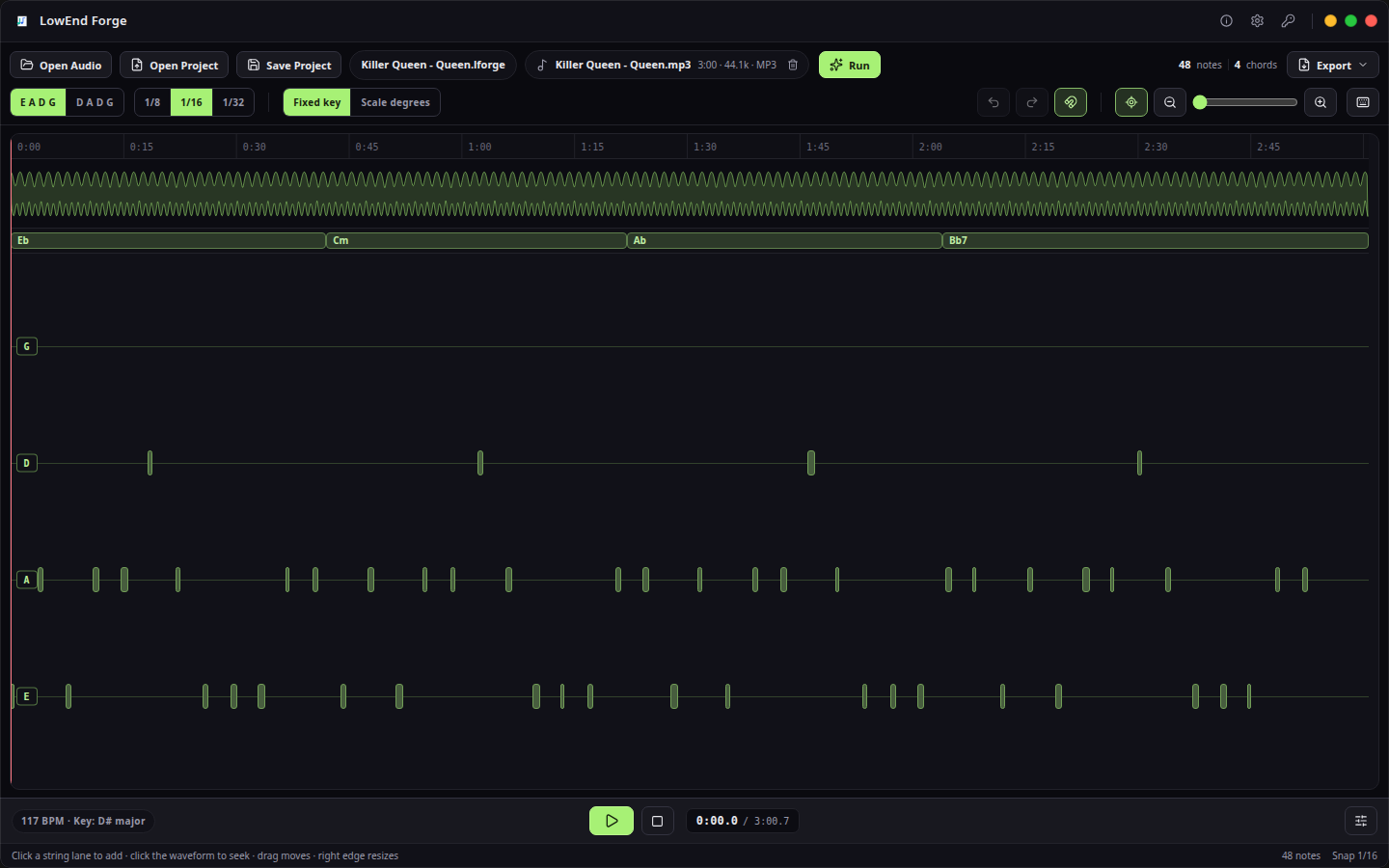
Audio waveform, detected notes, bass tab, chords, and export preview.
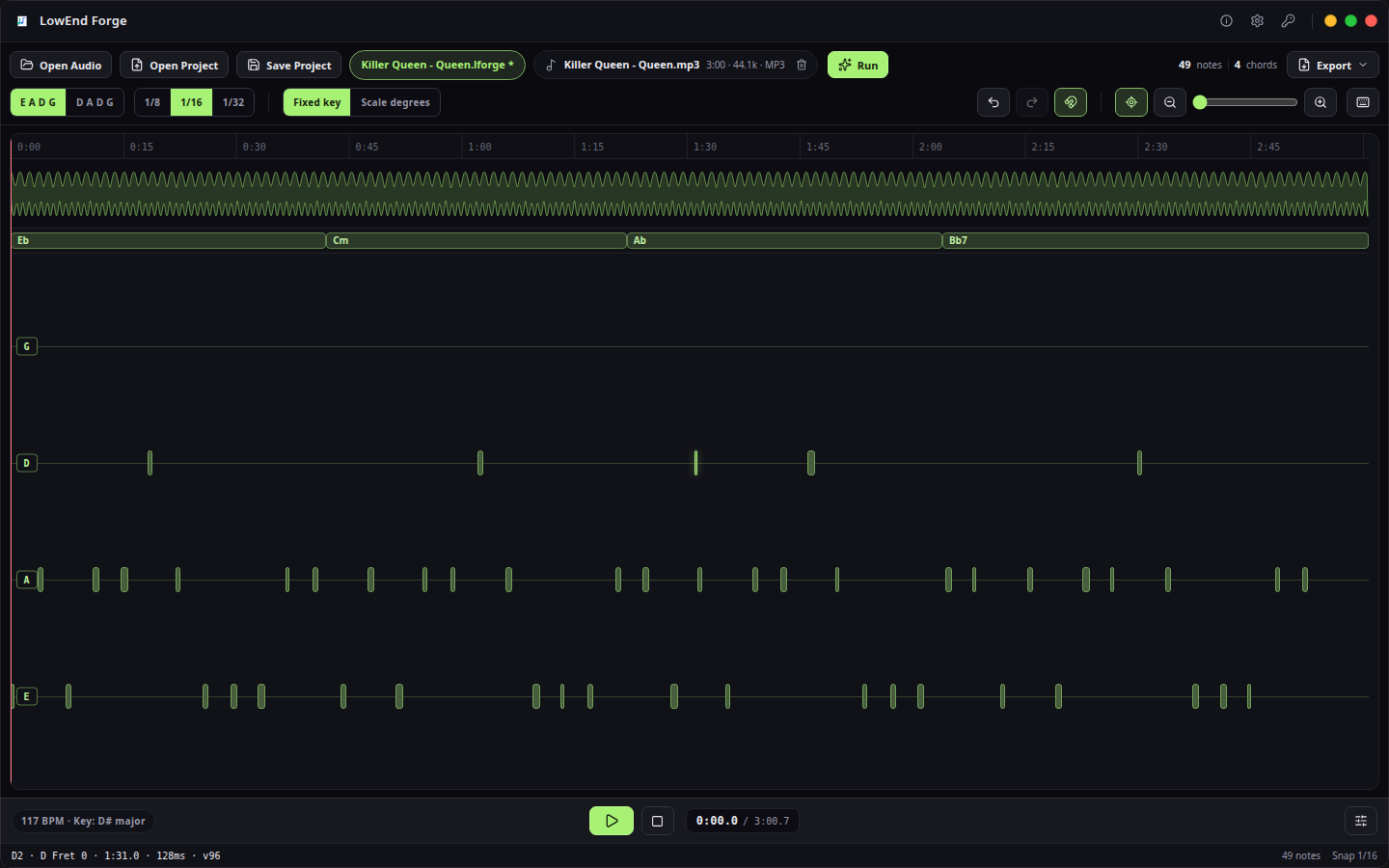
A close view of detected bass lines and fretboard positions.
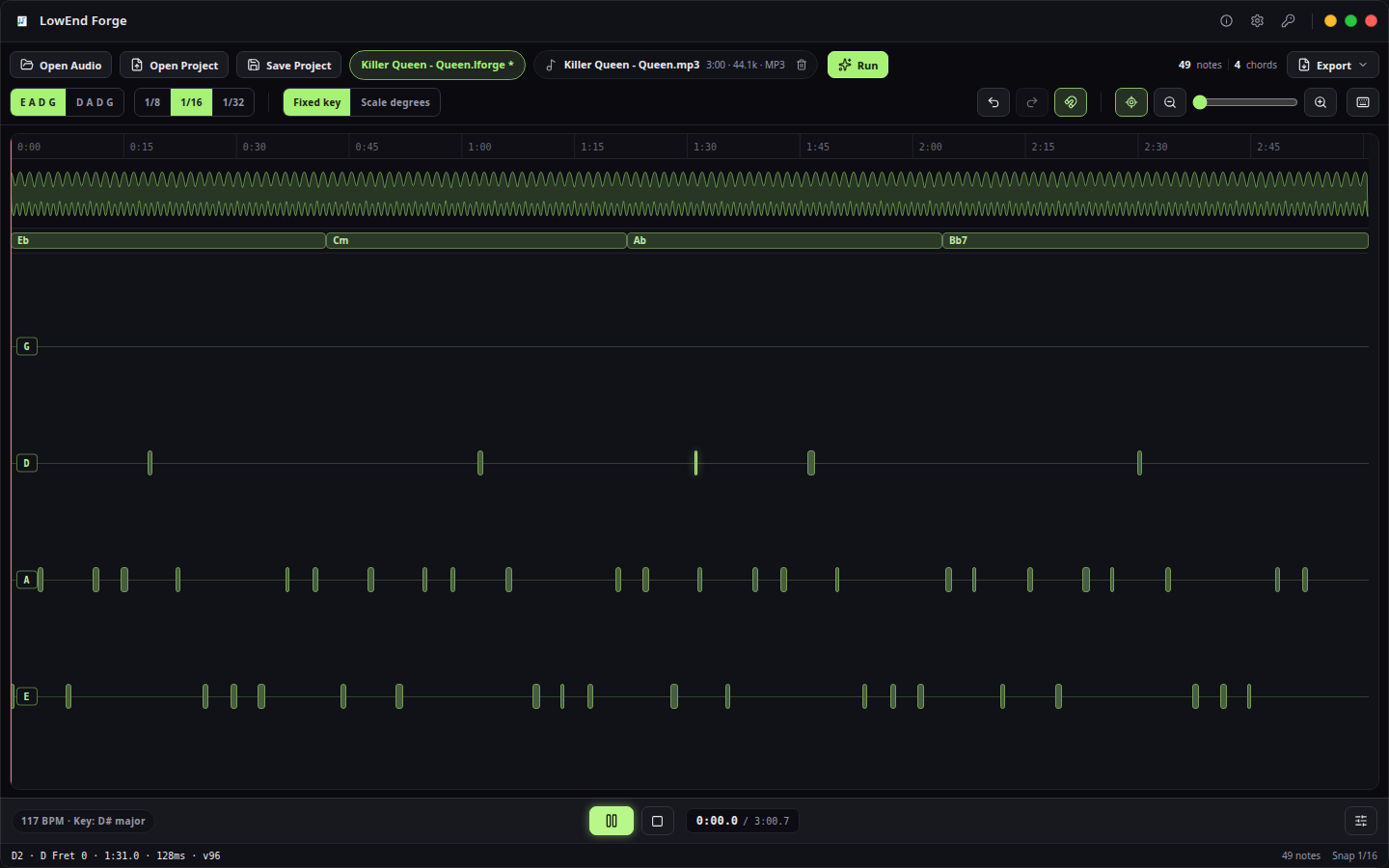
Follow the detected bass line against the audio timeline before exporting.
LowEnd Forge is a desktop workflow. Your working files stay on the machine unless you deliberately export or share them. The product page documents the exact capability boundary so the focused workflow can be evaluated on real evidence.
- Editing and correcting tab
- Export formats and their current boundaries
- Quickstart: "your first transcription"
Community scope: Community Edition keeps bass detection and tab viewing free; editing, quantization, projects, and export are optional licensed workflows.
What's the difference between LowEnd Forge and Soundslice or Guitar Pro for bass transcription?
Soundslice and Guitar Pro are powerful notation platforms built for multi-instrument playback. The Community Edition is free. Optional licensed capabilities add advanced workflows; see the product page for current access details. Workflow details: isolate the low-end signal, draft four-string tab, edit musical decisions against the waveform, and export. See the full comparison.
Does LowEnd Forge create perfect bass tabs automatically?
No. It creates editable bass-tab drafts from local audio. The product speeds up transcription, it doesn't replace the bassist's ear.
Are audio files uploaded for transcription?
No. The workflow is designed for local desktop analysis — practice recordings, lessons, and song files stay on your machine.
How much does LowEnd Forge cost?
The Community Edition is free for bass-detection preview and tab review. Optional licensed export and editing workflows use the current in-product or store terms. There is no recurring subscription.
Who uses LowEnd Forge?
Bass players, teachers, and transcribers who want to turn songs into editable four-string bass tab — isolate the bass, follow the waveform, correct the musical decisions, and export a chart that can leave the room.
- Bugs: open a structured bug report
- Ideas: request a focused workflow improvement
- Product help: documentation and troubleshooting
- Private support: support@hannes-software.com
- Security reports: follow SECURITY.md; do not post sensitive files, credentials, patient data, or private captures in public issues.
This is the official public distribution and community repository for LowEnd Forge: verified release links, current screenshots, documentation routes, issue intake, and security guidance. Product development happens in a private workspace; public issues here are the right place to report reproducible product behavior and request focused improvements.