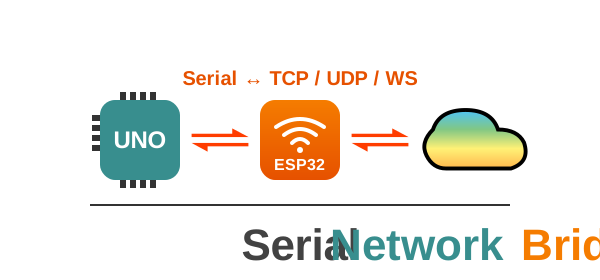



The Arduino Serial bridge for TCP, UDP, WebSocket, and AsyncTCP Clients
Enable advanced network functionality on non-networked boards by bridging them to a WiFi‑capable device (ESP32/ESP8266) or a PC via USB.
It is designed for Arduino boards such as AVR, STM32, and Teensy that lack built‑in WiFi or Ethernet. By bridging communication through modules like ESP32, Raspberry Pi Pico W, or even a PC running a Python script, the library makes network access broadly available. With support for SSL/TLS, WebSockets, and UDP, SerialNetworkBridge enables secure communication without requiring firmware‑level certificate management.
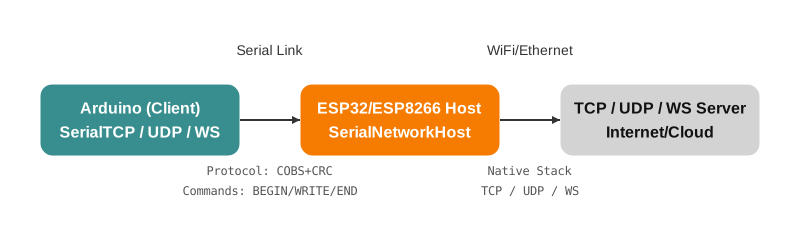
You can deploy this library in two ways depending on your hardware:
Use a WiFi-capable microcontroller as a dedicated network co-processor.
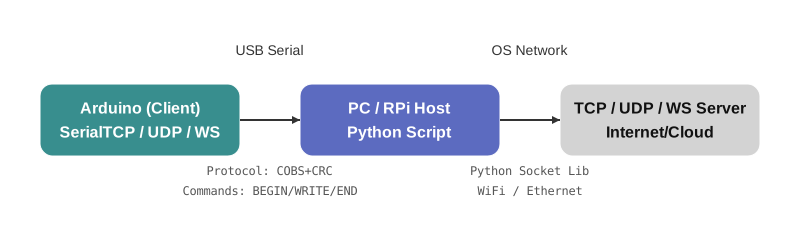
Use your computer (Windows, Linux, macOS) or Raspberry Pi as the gateway via the USB cable.
- Multi-Protocol Support: Bridge TCP, UDP, WebSocket, and AsyncTCP clients via serial.
- Universal Compatibility: Works with any interface implementing the
Streamclass. - PC Host Mode: Connect directly to a PC/Raspberry Pi via USB for internet access.
- Secure: Support for SSL/TLS (HTTPS/WSS) and STARTTLS.
- Performance: Supports
NeoHWSerialfor AVR. - AsyncTCP Support (New): Non-blocking, event-driven TCP for high-throughput applications (Requires Dual-Core ESP32 Host).
- Open Arduino IDE.
- Go to Sketch → Include Library → Manage Libraries…
- Search for SerialNetworkBridge.
- Click Install.
- Open your project’s
platformio.ini. - Add the library under
lib_deps:
lib_deps =
mobizt/SerialNetworkBridgeClients (Non-Networked Boards):
- Arduino AVR (Uno, Mega2560, Nano)
- STM32 series
- Teensy boards
- Any board with a
Streaminterface.
Hosts (Network Bridges):
- Microcontrollers: ESP32, ESP8266, Raspberry Pi Pico W, MKR WiFi 1010.
- PC / Linux (USB): - Windows (requires Admin for WiFi control).
- Linux / Raspberry Pi (requires Sudo/NetworkManager).
- macOS (requires Sudo).
These sketches run on your non-networked board. They connect to the "Host" (Arduino device or PC) to access the internet.
If you are using the PC Host Bridge, you must follow these rules in your client sketch:
- Using Relay Debug instead of System Debugging: Comment out
#define ENABLE_LOCAL_DEBUG. Use the predefined helper functions (debug::prnt,debug::printRaw,debug::printNewLinr) withHOST_RELAY_DEBUGto relay the debug message to PC terminal. - Use Main Serial: Pass
Serial(USB) to the client constructor. - Flush Bootloader: Add
Serial.write(0x00); delay(500);insetup(). - Explicit SSL: Pass
trueas the 3rd argument toconnect()for HTTPS (e.g.,client.connect("site.com", 443, true)).
// [PC Host] Comment out debug to prevent protocol corruption
// #define ENABLE_LOCAL_DEBUG
#include <SerialNetworkBridge.h>

// Use Serial for PC Host, Serial2 for ESP32 Host
SerialTCPClient client(Serial, 0);

void setup() {
  Serial.begin(115200);
  while(!Serial);

  // [PC Host] Flush bootloader garbage
  Serial.write(0x00);
  delay(500);

  if (client.pingHost(500)) {
    // 3rd param 'true' enables SSL/TLS (Required for PC Host HTTPS)
    if (client.connect("httpbin.org", 443, true)) {
      client.println("GET /get HTTP/1.1");
      client.println("Host: httpbin.org");
      client.println("Connection: close");
      client.println();
      // Read response...
    }
  }
}

void loop() {}#include <SerialNetworkBridge.h>
SerialWebsocketClient ws(Serial, 0);
void onWsEvent(WSMessageType type, const uint8_t* payload, size_t len) {
if(type == WS_EVENT_CONNECTED) {
// Connection Success
}
}
void setup() {
Serial.begin(115200);
while(!Serial);
Serial.write(0x00); delay(500); // Flush
ws.onEvent(onWsEvent);
ws.connect("echo.websocket.org", 443, "/", true);
}
void loop() {
ws.loop(); // Essential for events
}Use this for non-blocking HTTP requests or high-performance streaming.
#define USE_ASYNC_CLIENT // Required for Async support
#define ENABLE_LOCAL_DEBUG
#include <SerialNetworkBridge.h>

SerialAsyncTCPClient asyncClient(Serial1, 0); // Use Bridge Serial

void onData(void* arg, SerialAsyncTCPClient* c, void* data, size_t len) {
  Serial.print("Received: ");
  Serial.write((uint8_t*)data, len);
}

void setup() {
  Serial.begin(115200);

  Serial1.begin(115200); // Bridge

  asyncClient.onData(onData);
  asyncClient.onConnect([](void* arg, SerialAsyncTCPClient* c) {
    c->write("GET / HTTP/1.1\r\nHost: example.com\r\n\r\n");
  });

  asyncClient.connect("example.com", 80);
}

void loop() {
  asyncClient.loop(); // Critical for event processing
}Upload the Host sketch to an ESP32/ESP8266. It bridges Serial traffic to WiFi.
- Example:
examples/Device_Host/Generic_Client/Host/Host.ino
Use your computer as the bridge via USB! Supports real system network management.
- Install Dependencies:
Navigate to
examples/PC_Hostand run:- Windows:
install_libs.bat - Linux/Mac:
./install_libs.sh
- Windows:
- Configure:
Edit
serial_bridge.py: SetSERIAL_PORT(e.g.,COM3,/dev/ttyUSB0) andBAUD_RATE. - Run:
- Windows:
run.bat(Run as Administrator for WiFi/Reboot features). - Linux/Mac:
./run.sh(Run withsudofor WiFi/Reboot features).
- Windows:
If you use the SerialAsyncTCPClient feature, a Dual-Core ESP32 (e.g., ESP32-WROOM, ESP32-S3) is strongly recommended.
- Single-Core Devices (ESP32-C3, ESP32-S2): May experience data packet loss or connection stalls (receiving only ~1400 bytes) due to CPU contention between the Network Stack and Serial processing.
- Recommendation: Use the standard synchronous
SerialTCPClienton single-core devices.
connect(host, port, [ssl]): Connect to a TCP server. Passtruefor SSL on PC Host.setCACert(filename): Load a custom Root CA file (relative path on PC).startTLS(): Upgrade connection to SSL (e.g., for SMTP).
pingHost(): Check if bridge is running.setWiFi(ssid, pass): Set Wi-Fi credentials on Host (PC or ESP32).connectNetwork(): Trigger Wi-Fi connection on Host (OS-level on PC).disconnectNetwork(): Disconnect Host Wi-Fi.rebootHost(): Reboot the Host (Restarts script on PC, reboots ESP32).
This library is released under the MIT License.
See LICENSE for details.
Developed and maintained by mobizt.