A modular, console-based Data Structures & Algorithms library written entirely in C, built from scratch with pointer-level control, manual memory management (malloc / free), and defensive input validation.
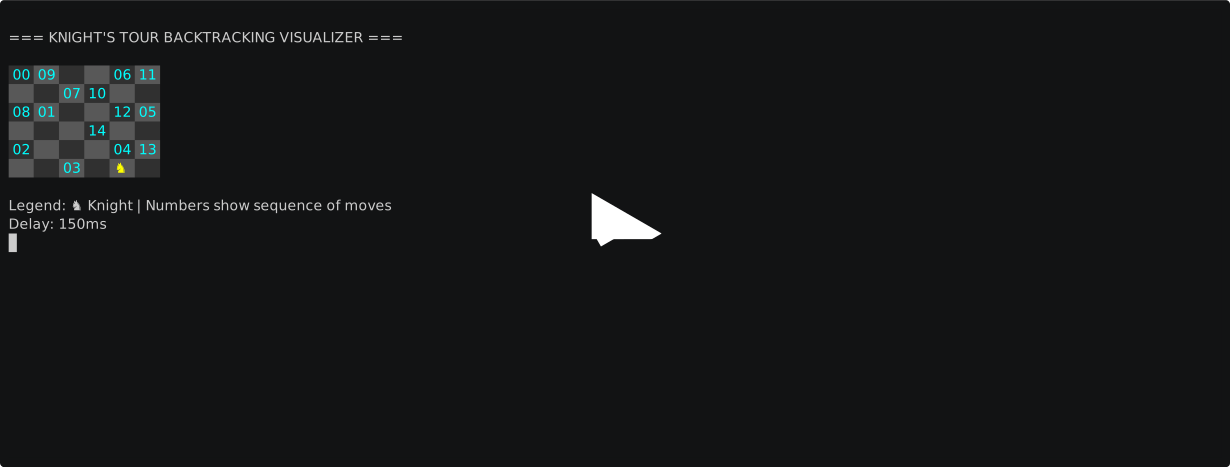
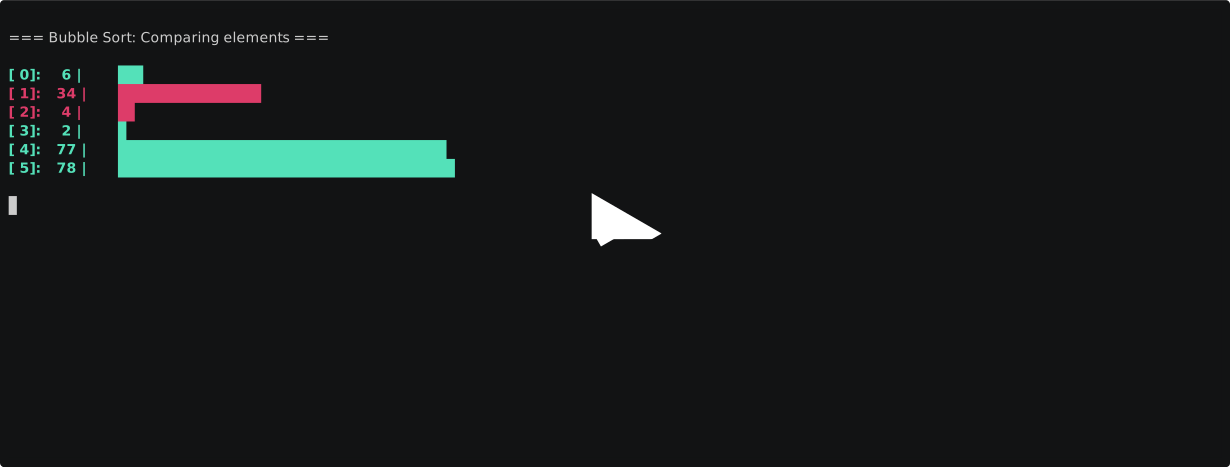
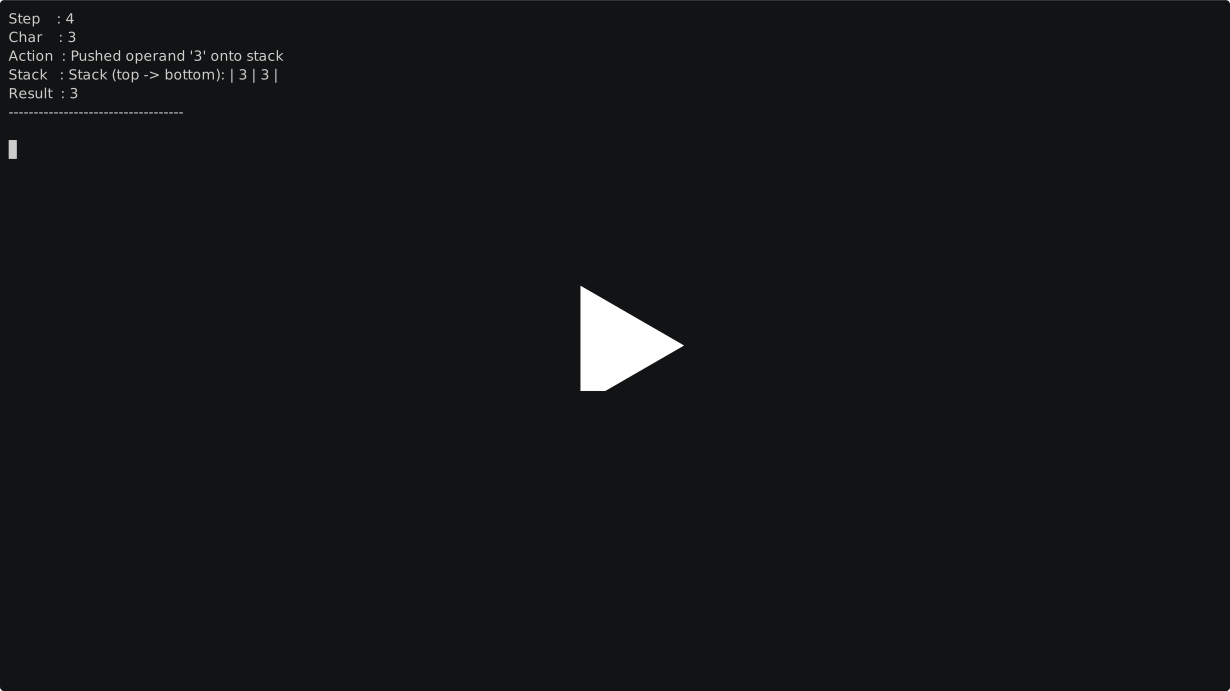
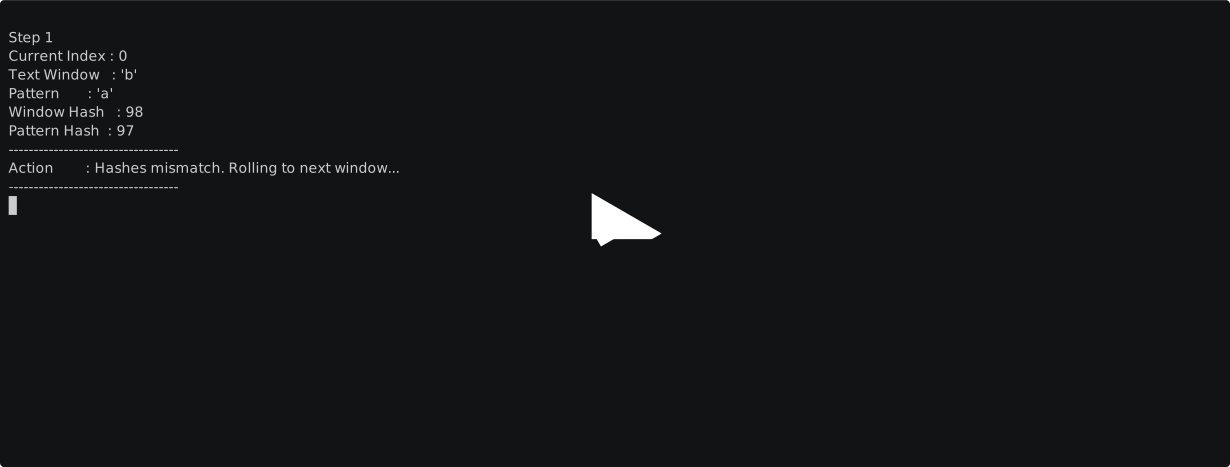
This project emphasizes conceptual clarity, low-level fundamentals, and explicit memory reasoning. It is designed with an educational intent, allowing learners to observe, experiment with, and understand data structures and algorithms step-by-step through an interactive terminal-based interface.
The codebase is structured as a reusable DSA library, with an interactive, console-driven demo layer built on top.
This project includes a Makefile and CMakeLists.txt to simplify building across multiple directories.
- GNU Make ≥ 4.4.1
- GCC (or a compatible C compiler)
The Text User Interface (TUI) is built using the Ncurses library.
sudo apt install libncurses5-dev libncursesw5-devsudo dnf install ncurses-develsudo pacman -S ncursesNote: The TUI is supported on Unix/Linux systems. On Windows, the project automatically falls back to the legacy CLI interface.
makeThis generates a single executable:
dsa(Linux / macOS)dsa.exe(Windows)
Alternatively, you can compile the application and tests using CMake:
mkdir build && cd build
cmake ..
make
To execute all unit tests using CTest:
ctest --output-on-failuremake run Builds only when necessary and launches the program.
make testRuns all tests and generates test binaries
make fmtOrganizes code style according to the standards defined in .clang-format
make valgrindRuns Valgrind over test binaries to look for memory leaks / use after free errors
make cleanRemoves executables and generated object/test binaries.
Docker acts as a cross-platform wrapper around the build system. Contributors on Windows, macOS, and Linux can use the same isolated Ubuntu environment without manually configuring compiler toolchains, build dependencies, or platform-specific settings.
The current build flow is:
Docker Container
      ↓
   Makefile
      ↓
GCC Compilation
      ↓
dsa Executable
The Docker image installs the required build tools and executes the project's Makefile, ensuring consistent builds across different operating systems.
Each component serves a different purpose:
- Docker provides a reproducible Linux build environment.
- The Makefile defines the primary build workflow used by the project today.
- CMakeLists.txt provides an alternative build system that can generate platform-specific build files while supporting testing and future expansion.
These tools are complementary rather than competing solutions.

This project includes a GitHub Actions CI pipeline that automatically verifies code correctness and memory safety.
On every push or pull request:
-
A fresh Ubuntu VM is allocated
-
The project is compiled using GCC
-
The complete unit test suite is executed
-
All test binaries are run under Valgrind to check for:
- memory leaks
- invalid reads / writes
- use-after-free errors
- uninitialized memory usage
If any test fails or Valgrind detects a memory error, the CI job fails automatically.
- Linear Search: O(n)
- Binary Search: O(logn)
- Interpolation Search: O(log(logn))
- Jump Search: O(√n)
- Bubble Sort: O(n²)
- Selection Sort: O(n²)
- Insertion Sort: O(n²)
- Shell sort: O(nlogn)
- Quick sort: O(n²)
- Merge sort: O(nlogn)
- Heap sort: O(nlogn)
- Radix sort (LSD): O(nk)
- Bucket sort :O(n+k)
- GBFS: O(b^m)
- BFS: O(V+E)
- DFS: O(V+E)
- Dijkstra's Algorithm: O((V+E)log V)
- A* Search: O((V+E)log V)
- Greedy Best-First Search: O((V+E)log V)
- Bellman-Ford: O(V·E)
- Floyd-Warshall: O(V³)
- Topological Sort (Kahn's Algorithm): O(V+E)
- Strongly Connected Components (Tarjan & Kosaraju): O(V + E)
- Maximum Flow (Edmonds-Karp): O(V·E²)
- Maximum Flow (Dinic's Algorithm): O(V²·E)
- Bipartite Matching (Hopcroft-Karp): O(E·√V)
- Eulerian Path (Hierholzer's Algorithm): O(V + E)
- FCFS(First come,First Served): O(n)
- SJF( Shortest Job First): O(nlogn+n)
- Priority Scheduling: O(nlogn)
- SRTF (Shortest Remaining Time First): O(nlogn)
- Preemptive Priority Scheduling: O(nlogn)
- Naive String Matching: O(n-m+1)
- Knuth-Morris-Pratt (KMP) Algorithm: O(n+m)
- Rabin-Karp Algorithm: O(n.m)
- Fibonacci (DP): O(n)
- Longest Common Subsequence (LCS): O(nm)
- 0/1 Knapsack: O(nW)
- Matrix Chain Multiplication: O(n³)
- Rat in a Maze: O(4^(n²))
- Graph Coloring: O(m^V)
- Sudoko solver: O(6^m)
- Knight's tour:O(8^(n^2))
- N Queen's algorithm: O(N!)
- Binomial Heap:
- Insert: O(log n) (worst case) / O(1) (amortized)
- Find Min: O(log n)
- Extract Min / Delete: O(log n)
- Merge: O(log n)
- Fibonacci Heap:
- Insert: O(1)
- Find Min: O(1)
- Extract Min / Delete: O(log n) (amortized)
- Merge: O(1)
- Leftist Heap:
- Insert / Merge / Extract Min: O(log n)
- Skew Heap:
- Insert / Merge / Extract Min: O(log n) (amortized)
- Min-Max Heap (Double-Ended Priority Queue):
- Find Min / Max: O(1)
- Insert / Extract Min / Extract Max: O(log n)
- d-Ary Heap:
- Insert / Decrease Key: O(log_d n)
- Extract Min: O(d·log_d n)
- Treap (Tree + Heap):
- Search / Insert / Delete: O(log n) (average/expected)
This project is licensed under the MIT License - see the LICENSE file for details.
Darshan Parekh and many contributors....
Aspiring systems engineer and cybersecurity engineer